
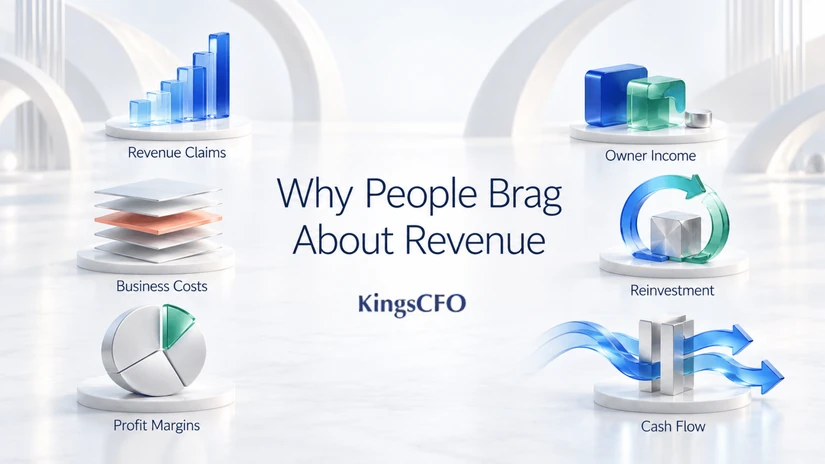
Revenue vs Profit and Why People Brag About Revenue
You see a founder announce AED 5 million in annual revenue, but there’s no mention of what the business spent to earn it. How much did they actually keep? That question sits at the centre of revenue vs profit.
If you run a small business in Dubai, that missing information is important because you could be comparing your own earnings with another company’s sales before expenses. When you’re carefully managing salaries and supplier payments, their announcement can make you question your progress, even though it tells you very little about their financial position.
While researching revenue vs profit, I discussed this question with a finance expert from our CFO services in Dubai team. They explained that owners may share revenue to show the scale of their business, keep their margins private, or simply report the figure they know best.
Once you understand what those announcements include, you can assess them without assuming another owner is doing better than you. Let’s look at revenue vs profit: why people highlight revenue, what their figures leave out, and which numbers help you judge your own progress.
Why Do People Share Revenue Instead of Profit?
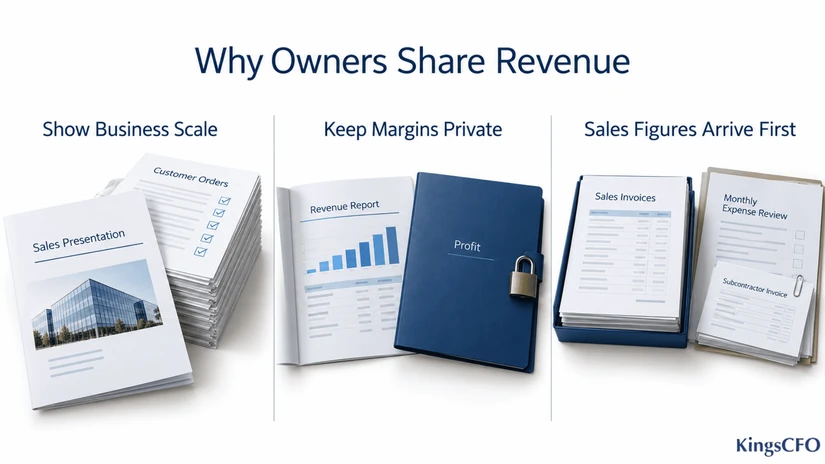
Revenue gives someone a quick indication of how much a business sells, which makes it useful when an owner wants to describe the size of their company. Because it comes before expenses, it also usually creates a more impressive headline than profit.
The reason for sharing it can range from attracting customers to seeking recognition. That means you need some context before deciding what an announcement says about the business or the person behind it.
A Large Revenue Figure Can Make a Business Look Established
If you’re considering a supplier for a substantial contract, knowing that they have handled a significant volume of sales may make you more comfortable approaching them. Our finance expert explained that some founders mention revenue for this reason when speaking with potential clients, landlords, and business contacts.
Although revenue can indicate sales activity, you would still need to check the supplier’s resources, delivery record, and finances before trusting them with the work.
There can also be a desire to impress, as a large sales number allows an owner to present an achievement without discussing the expenses or borrowing behind it.
Research offers some context for that behaviour. In three experiments, Irene Scopelliti of City University London and her co-authors found that people overestimated positive reactions to their self-promotion and underestimated negative reactions. The research did not examine revenue announcements specifically, so it cannot establish why an individual owner shares their figures.
When you hear a revenue claim, remember the difference between profit and revenue and treat it as information about reported sales rather than evidence of the owner’s wealth. To understand how well the business is doing financially, you would also need to know its costs, debts, and available cash.
Keeping Profit Private Can Protect Commercial Information
You might wonder why an owner cannot share profit alongside revenue, especially if they want to demonstrate success.
Our expert explained that revealing a profit margin can expose information an owner would prefer to keep out of negotiations. A customer who learns that a supplier earns a substantial margin might use that information to request a lower price, while a competitor could consider it when pricing similar work.
Neither response is guaranteed, but the possibility helps explain why an owner might discuss sales publicly while keeping profit confidential.
You therefore cannot conclude that a business is unprofitable simply because its owner does not disclose earnings. You can only conclude that the revenue figure gives you too little information to judge its revenue vs profit position.
Some Owners Know Their Sales Before They Know Their Profit
In other cases, an owner shares revenue because it is the figure they can access most easily. They may approve quotations and monitor invoices every day, while their accountant calculates profit after reviewing the month’s expenses.
That review matters because some costs may not yet appear in the accounts. For example, a subcontractor could have completed work without submitting an invoice, leaving the initial profit estimate higher than it should be.
Our finance expert described checking for missing costs and accounting adjustments before relying on an owner’s estimate of earnings.
If this sounds familiar, a monthly accounting and bookkeeping review can help you establish which costs belong to the work you have already recorded. You can then assess the month’s performance using a more complete profit figure.
Revenue vs Profit Starts With Knowing Which Costs Are Included

Revenue is the income your business earns from selling goods or services before deducting expenses. The difference between profit and revenue is that profit is the amount left after costs, but the figure changes depending on which costs you deduct.
That is why someone saying “we made AED 40,000 profit” still needs to explain what they mean.
| Profit Measure | How It Is Calculated in a Simple Business Example | What It Helps You Understand |
|---|---|---|
| Gross profit | Revenue minus direct costs of goods or services | How much remains to cover overheads and other expenses |
| Operating profit | Gross profit minus operating expenses | How much the business earns from its operations before financing costs and tax |
| Net profit | Revenue minus all recognised expenses, including interest and tax | How much accounting profit remains for the period |
Suppose your business earns AED 100,000 in revenue and incurs AED 60,000 in direct costs. Your gross profit is AED 40,000, but you still need to deduct expenses such as office rent and administrative salaries.
If those operating expenses total AED 25,000, your operating profit falls to AED 15,000. A further AED 5,000 in interest and tax leaves AED 10,000 in net profit.
All three figures describe the same business, but each one answers a different revenue vs profit question. Before comparing your earnings with someone else’s, check that you are using the same profit measure and reporting period.
A Smaller Business Can Leave More Profit After Expenses
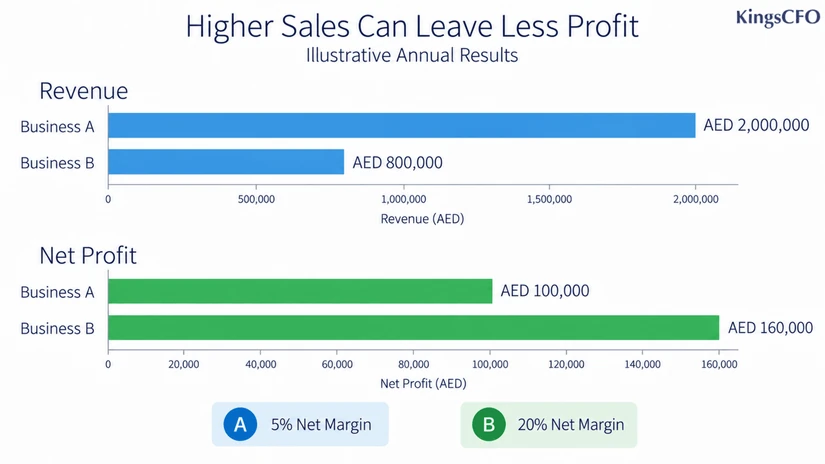
Once you know which profit figure you are comparing, you can look at how much of each sale the business retains. Net profit margin shows this by expressing net profit as a percentage of revenue.
Net profit margin = Net profit ÷ Revenue × 100
Consider these hypothetical results for two businesses over the same year.
| Measure | Business A | Business B |
|---|---|---|
| Revenue | AED 2,000,000 | AED 800,000 |
| Net profit | AED 100,000 | AED 160,000 |
| Net profit margin | 5% | 20% |
Although Business A sells two and a half times as much, Business B earns AED 60,000 more net profit. That happens because Business B retains twenty fils from each dirham of revenue, compared with five fils at Business A.
These figures alone do not establish which business is a better investment, because you would also need to consider its risks, funding needs, and future prospects. They do show why, in revenue vs profit terms, a larger revenue announcement does not necessarily mean higher earnings.
If you are comparing your own progress with another business, look at both the profit amount and the margin. The amount tells you what it earned, while the margin shows how much of its sales remained after expenses.
How More Sales Put Pressure on a Dubai Contractor

Our finance expert shared an anonymised example of a Dubai fit-out and joinery business that struggled to meet payroll despite rapid sales growth.
According to the expert, unbilled site changes and overtime contributed to its gross margin falling from 32% to 17.5%. Although the company was taking on more work, the direct costs of completing that work were consuming a larger share of its revenue.
The problem became harder to manage because customers took approximately 118 days to pay, while suppliers expected payment in about 35 days. As a result, the company had to fund project costs long before it collected the related customer payments.
The finance team responded by tightening project selection, setting a minimum gross-margin requirement, and requesting larger advance payments before production began.
What stood out to me was how the sales figure concealed two separate pressures. The business earned less gross profit from each dirham of revenue, and it had to wait longer to receive the cash needed to cover its commitments.
If winning more contracts is making your finances harder to manage, review the margin and payment schedule for each project. Those checks can help you understand why additional work is failing to improve your position.
When Prioritising Revenue Growth Can Make Sense

In revenue vs profit terms, lower profit does not always mean that growth is going badly. A business may spend more on hiring or building capacity now because it expects those investments to support future sales.
To assess that decision, our finance expert starts by examining how much each additional sale contributes after the costs that increase with it.
For example, suppose you charge AED 1,000 for a service and spend AED 600 on the variable costs of winning and delivering it. The remaining AED 400 helps cover fixed expenses, such as office rent, before contributing to profit.
If you reduce the price to AED 550 while those variable costs remain AED 600, each additional sale loses AED 50 before covering any fixed expenses. Selling more at that price increases the loss unless the economics change.
Before accepting lower profit to pursue growth, establish:
- How much each additional sale contributes after its variable costs.
- Which expansion expenses will end and which will continue.
- When the investment should begin improving earnings.
- How you will fund expenses until customers pay.
Our growth modelling and financial planning support can help you test these assumptions before committing to additional staff, equipment, or premises.
Company Profit Does Not Tell You Everything About the Owner’s Income

Revenue vs profit comparisons become more complicated when the owner also works in the business, because their salary may already be included in its expenses.
Suppose a company earns AED 400,000 before the working owner’s salary and corporate tax. If it records an AED 240,000 salary expense, it has AED 160,000 remaining before tax, assuming no other adjustments.
The company’s remaining profit is lower, but the owner has received compensation for their work. If you compare it with a business whose owner works without a recorded salary, the figures may give you a misleading impression of their relative performance.
You also need to distinguish salary from dividends and personal withdrawals. Dividends distribute earnings rather than reduce profit as an operating expense, while the treatment of an owner’s withdrawal depends on the business structure and the nature of the payment.
For UAE tax purposes, recording an expense does not automatically make it deductible. The Federal Tax Authority’s guidance on connected-person payments explains that relevant deductions must reflect market value and relate wholly and exclusively to the business.
When comparing profit vs revenue between businesses, check how each one accounts for the owner’s work. For your own records, our accounting and tax compliance services can help you distinguish salary, business expenses, and personal withdrawals.
Why “We Reinvest Everything” Needs an Explanation

An owner may explain low profit by saying they put everything back into the business. That can be reasonable, but you need to know what they spent the money on because different purchases affect profit differently.
Paying for an advertising campaign can create an expense in the current period. Buying equipment may instead spread the expense over the years the business expects to use it.
For example, assume a company buys equipment for AED 600,000, expects to use it for five years, and estimates that it will have no remaining value at the end. If it spreads the cost evenly through straight-line depreciation, it records an expense of AED 10,000 a month once the equipment is available for use.
Although the company may pay the full purchase price immediately, it does not deduct the entire AED 600,000 from that month’s profit under those assumptions.
Similarly, keeping earnings in the company’s bank account does not reduce the profit already earned. It simply means the business has retained the money rather than distributed it.
Before making a major purchase, use financial advisory support to examine its effect on both profit and cash. This helps you avoid assuming that an affordable monthly accounting expense means you can comfortably fund the upfront payment.
What to Check Before Trusting a Revenue Screenshot

A payment dashboard or an AI-generated financial summary can make a number easy to share, but you still need to understand what the report measures.
For example, AED 90,000 in monthly sales becomes AED 1.08 million when multiplied by twelve. That calculation gives an annualised rate, not proof that the business earned AED 1.08 million over a full year.
If the month included a seasonal peak or an unusually large order, treating it as a typical month could overstate normal performance.
The same principle applies to other figures you may see online.
| Reported Figure | Context You Need |
|---|---|
| One month’s sales multiplied by twelve | Is that month representative of the rest of the year? |
| Total customer payments | How does the report treat VAT, refunds, and adjustments? |
| Invoices issued | How much has been collected, and how much remains unpaid? |
| Total transaction value | How much belongs to the business, and how much does it handle for other parties? |
| Profit shown on a dashboard | Are all relevant expenses and accounting adjustments included? |
If you use automated reporting in your own business, check these definitions before relying on the summary. Faster access to a figure is useful only when you understand what went into it.
Why a Profitable Business Can Still Struggle With Payroll

Even after you settle revenue vs profit, a complete profit figure cannot tell you if the business has enough cash to pay its bills today, because earning revenue and receiving payment can happen at different times.
The U.S. Securities and Exchange Commission explains that income statements report profit or loss, while cash flow statements show cash movements. You need both because a profitable transaction can leave the business waiting for payment.
Consider a simplified events agency example. The agency completes AED 500,000 of work and incurs AED 250,000 in direct costs plus AED 100,000 in other operating expenses, leaving AED 150,000 before any remaining expenses and tax.
Under accrual accounting, which records revenue when earned rather than only when payment arrives, the agency can recognise that revenue while the customer still owes the money.
If employees and suppliers need payment first, the agency must use existing cash or arrange funding to cover them. Its accounts may show a profit, but the unpaid customer invoice cannot fund payroll.
Before accepting a large contract, compare the expected customer payment dates with the dates you must pay suppliers and staff. Our cash flow forecasting support helps identify those gaps so you can discuss deposits, payment terms, or funding before work begins.
How to Judge Your Own Business Progress
You do not need access to another owner’s accounts to stop their revenue announcement from becoming an unfair comparison. Instead, use your own revenue vs profit figures to check if the business is improving in ways that support your goals.
Start with these five questions:
- Did higher sales produce more profit? Compare the change in revenue with the change in net profit, then check if your margin improved or fell.
- Did new work contribute enough after its variable costs? Review what you spent to win and deliver it before deciding that the extra sales were worthwhile.
- Did normal operations generate cash? Check if customer receipts covered operating payments or if you needed additional funding.
- Which customers are paying late? Review overdue invoices to see where you are funding work that has already been completed.
- How dependent are you on your largest customer? Assess how a delayed payment or lost contract would affect your ability to meet existing commitments.
These questions give you practical reasons to change pricing, improve collections, or reconsider a contract. A revenue target alone cannot tell you which of those actions your business needs, but a clear view of revenue vs profit can.
Use Revenue vs Profit to Make a Fairer Comparison
When someone shares a revenue milestone, you can acknowledge the achievement without assuming it reflects their profit, personal income, or available cash.
The most useful insight from my research and conversation with our finance expert was that you need to understand what a figure includes before using it to judge success. For your own business, that means checking how sales translate into earnings and how quickly those earnings become cash you can use.
You may find that your next improvement comes from collecting invoices sooner, pricing work more carefully, or negotiating deposits rather than increasing sales.
KingsCFO provides strategic financial advisory and outsourced finance support to SMEs in Dubai and across the UAE, including virtual and part-time CFO services. If you are considering hiring, spending, or expansion, book a conversation with our finance team to review what your figures mean for that decision.
FAQs
Is Revenue the Same as Turnover?
In many business conversations, turnover means sales revenue for a particular period. Check the context, though, because terms such as inventory turnover describe how quickly stock moves rather than the amount of revenue earned.
Is Net Revenue the Same as Net Profit?
Net revenue adjusts sales for items such as returns, discounts, and allowances. Net profit goes further by accounting for all recognised expenses, including operating costs, interest, and tax.
Is a 5% Net Profit Margin Bad?
A 5% net margin means the business retains five fils of net profit from each dirham of revenue. To assess it, compare similar businesses and consider how much room it leaves for rising costs or falling sales.
Can Revenue Increase While Profit Falls?
Yes. Revenue vs profit can move in opposite directions, because higher sales do not guarantee that income grows faster than expenses. Discounting, overtime, higher delivery costs, or additional overheads can reduce profit even as revenue increases.
Does a Million-Dirham Business Make Its Owner a Millionaire?
If the figure refers to annual revenue, it tells you about sales rather than the owner’s wealth. Personal wealth depends on the value of the owner’s assets, including their share of the business, after deducting liabilities.
Should a Small Business Focus on Revenue or Profit?
Track profit vs revenue alongside cash flow so you can assess sales, earnings, and your ability to make payments. If you temporarily prioritise growth, establish how you will fund it and when you expect it to improve profit.