
How Strategic Finance Helps Growing Businesses Choose Their Next Move
A growing business can show healthy revenue, rising profit, and controlled monthly expenses yet still hesitate over its next move. Can you afford to hire? Is this the right time to expand? Should available cash fund a new service, equipment, or an operation that already works?
I initially assumed that a profitable result would make these decisions easier, but our finance team clarified the gap. Profit may confirm that the business is earning, yet it does not reveal how much cash can be committed, how long that cash must last, or what happens when the expected return arrives late. Business growth is a long-term game where today’s cash must carefully fund tomorrow’s stability.
Strategic finance can add another layer of confusion. Is it genuinely different from financial planning, forecasting and FP&A, or simply a newer name for work your finance team already performs?Continue reading to understand how strategic finance guides real business decisions, where it differs from routine planning, and when your current reports may no longer provide enough direction.
What Is Strategic Finance?

Strategic finance uses financial and operational information to guide future business decisions. It brings together cash flow, forecasts, risk, and business goals so management can judge where to invest, when to wait, and what must be true before moving ahead.
“Financial records tell you where the business stands today. Strategic finance helps you decide where it can go next.”
– Santosh Kumar, CEO, KingsCFO
Cash flow is usually the starting point because a company needs to understand what is coming in, what is going out, and how long available cash can support its current commitments.
Once that position is clear, the discussion moves towards direction. How should the business use its money, leadership time and operating capacity? Which opportunity deserves attention first, and what level of risk can the company absorb?
The figures provide the evidence, but management still has to decide where its limited resources can create the strongest result.
Why Accurate Reports May Still Leave the Next Step Unclear
Monthly accounts can show revenue, expenses, receivables, current cash and profit, but they cannot automatically tell you if the business can carry another six months of payroll or fund a new location before it reaches break-even.
Profit and cash also answer different questions. Under IAS 7 Statement of Cash Flows, cash-flow reporting accounts for non-cash items and movements in areas such as inventories, receivables and payables, which means a profitable result does not necessarily leave the same amount available to spend.This is where many growing businesses reach a decision bottleneck.
The reports may be accurate, yet every hiring, investment or expansion choice still returns to the founder.Our experts look beyond the final number by examining where cash, management time and operating capacity are being consumed, then identifying which decisions should be funded, delayed, delegated or supported by stronger systems.
The harder questions begin after the report is prepared:
- How much cash will the decision absorb?
- Which assumptions must hold?
- What happens if revenue arrives later?
- How much downside can the business carry?
- What result would make management reconsider?
Your latest finance pack offers a useful test. Does it help leadership choose an action, or does it stop after describing performance?
How Traditional Finance, Financial Planning and Strategic Finance Differ
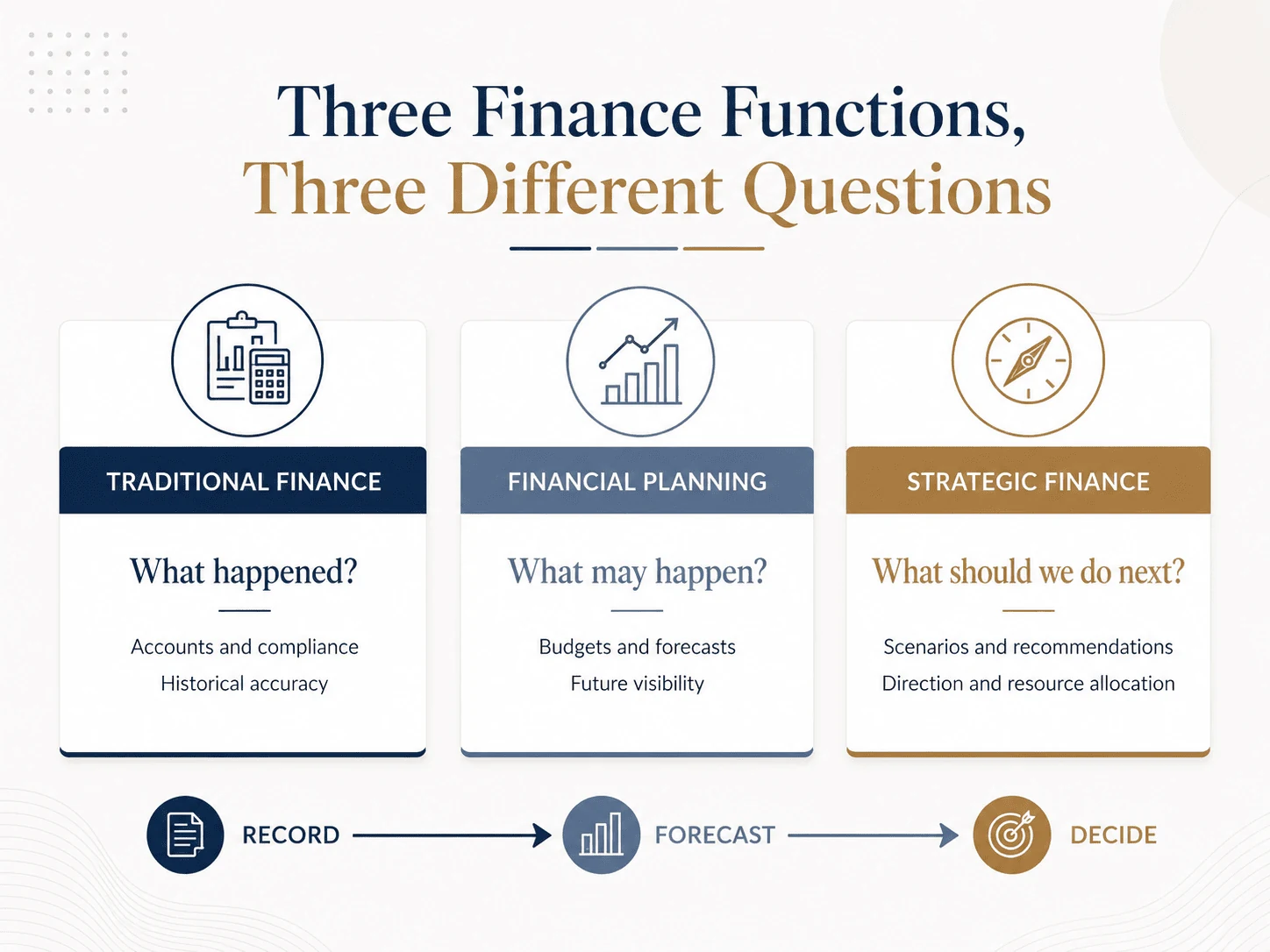
Traditional finance gives the company a reliable foundation by recording transactions, preparing statements, managing compliance and explaining what has already happened.
Financial planning looks ahead over a defined period and may include a budget, sales forecast, expense plan, financing requirement, and expected cash position.
Strategic finance uses both, then connects the numbers with the company’s direction and the decisions that could move it closer to that goal.
| Area | Traditional finance | Financial planning | Strategic finance |
|---|---|---|---|
| Main question | What happened? | What do we expect? | What should we do next? |
| Common output | Accounts and reports | Budgets and forecasts | Scenarios and recommendations |
| Main value | Accuracy and control | Financial visibility | Direction and resource allocation |
| Response to change | Reports the effect | Revises the plan | Reconsiders the decision |
Our experts separate these functions by the question each one answers. Traditional finance explains the past, financial planning estimates what may happen and strategic finance uses that information to shape the next move.
The boundaries are not rigid because a mature FP&A team may already handle scenario modelling, driver analysis, variance analysis and business partnering.
The department name matters less than the purpose of the work. When forecasts are prepared regularly but rarely influence action, the planning process may not yet be working strategically.
How Strategic Financial Management Turns a Goal Into a Decision
Suppose a company wants to open another location. Saying “we want to expand” expresses ambition, but it gives finance very little to test.
Begin With a Question That Can Be Measured
A better starting point would be: Can the company open another location within six months without placing the existing business under unacceptable cash pressure?
The goal now has a time frame and a risk boundary, giving management something specific to examine.
Clarify the Purpose First
Before the financial modelling begins, the decision needs a clear operational purpose. Why is the business pursuing this opportunity, what problem should it solve, and how much time is leadership prepared to give it?
Michael Porter established the modern framework for corporate strategy and stated that the essence of strategy is choosing what not to do. Without those answers, even a detailed forecast may support growth without clarifying where the company is trying to go.
Strategic financial management is not only about calculating the return. It also tests if the proposed use of cash, time and leadership attention supports the wider direction of the business.
Work Out What Must Be True
The analysis may need to cover:
- Setup, licensing and rental costs
- Payroll and recruitment timing
- Expected sales and gross margin
- Customer payment terms
- Working-capital requirements
- Time needed to reach break-even
- Management and operational capacity
Finance can then examine the required investment, possible reward, market conditions and the company’s ability to absorb an unfavourable result.
That wider view matters because customer relationships, operating realities and the owner’s long-term purpose may also influence the final choice.
Test More Than One Future
A single forecast presents only one possible result, so strategic financial planning must compare an expected case with lower sales, higher cost and delayed revenue outcomes. Legendary fund manager Howard Marks built his methodology around strict risk control and teaches that decision makers must constantly ask how much money they will lose if events do not go as planned.
Financial modelling allows management to change these variables and see exactly how each one alters cash, profit and the break even point.
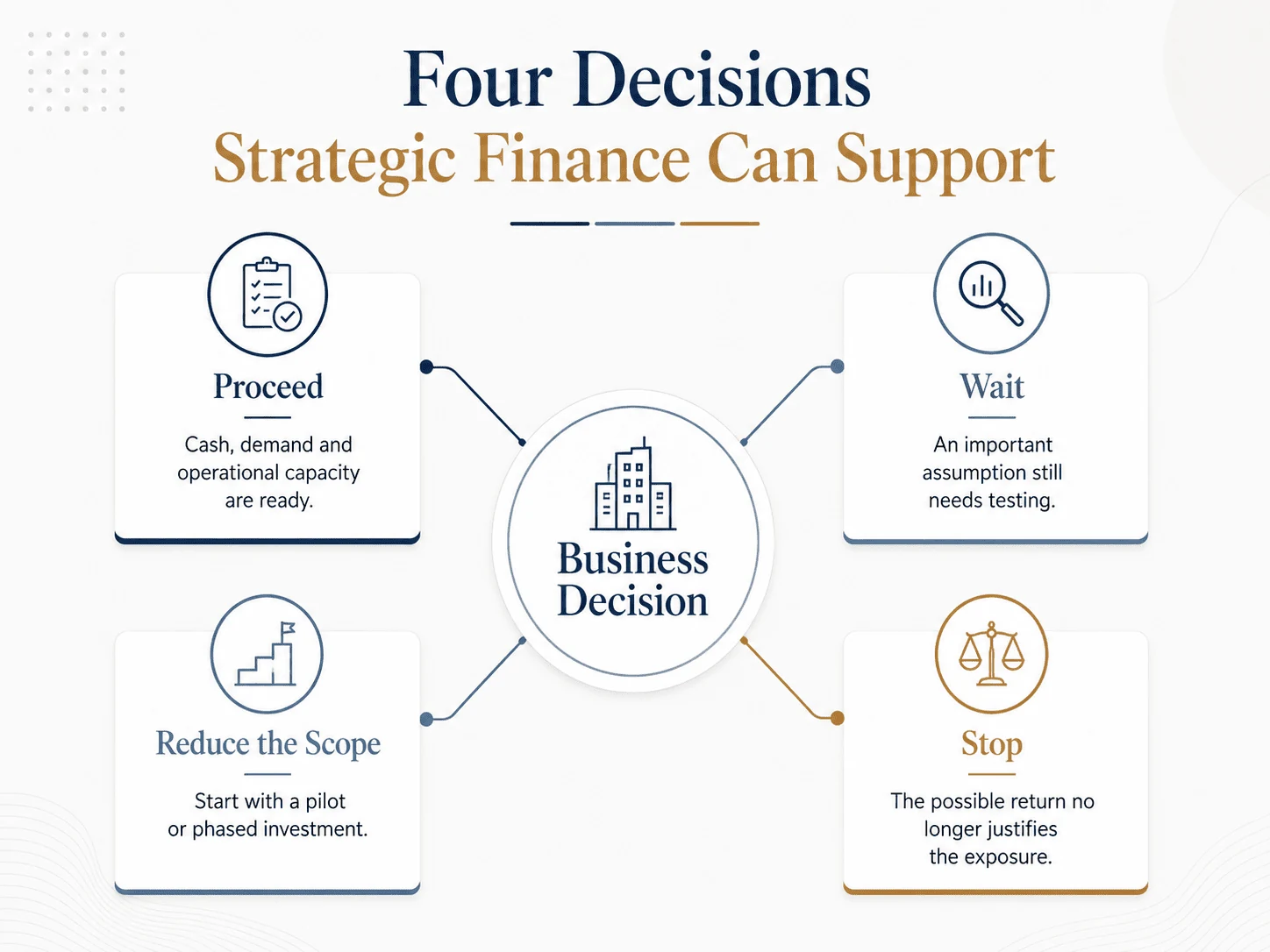
Our finance team also stressed that a sound recommendation is not always a simple yes or no, as the same idea may lead to several sensible responses:
- Proceed when cash, demand and capacity meet agreed levels.
- Wait while important assumptions are tested.
- Reduce the scope through a pilot or phased launch.
- Stop when the expected return no longer justifies the exposure.
A good opportunity may need better timing rather than rejection, and stronger reserves, clearer demand or a smaller first step can change the quality of the decision.
Where Strategic Finance Changes Real Business Decisions
The value becomes easier to see when strategic finance is applied to choices growing companies face regularly.
Can the Business Afford to Hire Now?
Hiring too early can strain cash long before the new employee begins adding value.
Salary is only the visible commitment because recruitment, benefits, onboarding, and the time required for the person to become productive all affect how long the business must carry the cost.
A useful business finance strategy connects that commitment with available cash, the expected contribution and a clear review point, making the decision easier to judge once management knows how long the role can be funded before it begins creating measurable value.
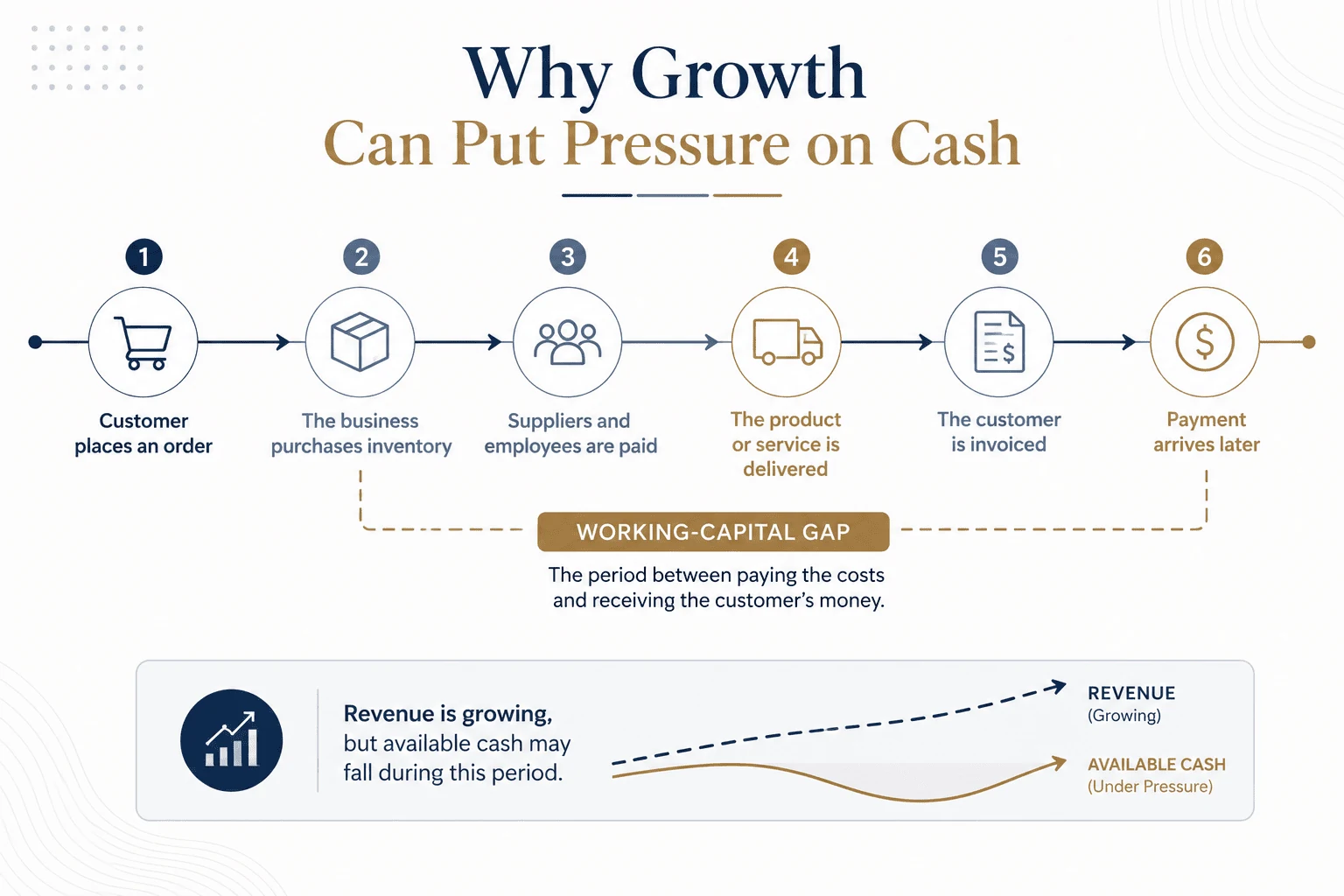
Can Revenue Rise While Cash Becomes Tighter?
Yes, growth often requires inventory, staff and supplier payments before customers pay.
The British Business Bank explains that even a profitable, high-growth company can run out of cash as its working-capital requirement increases.
This structural delay is known as the Cash Conversion Cycle, and misjudging it is fatal for expanding companies. According to research from CB Insights, running out of cash accounts for 70 percent of the reasons why most startups fail due to poor financial management and unmonitored burn rates.
Research published by the Harvard Business Review supports this, noting that without sufficient working capital, the act of growing itself becomes a massive source of financial pressure. A busy sales pipeline can easily hide a growing cash burden when slow customer payments, rising stock levels or supplier deposits absorb the money needed for payroll and expansion.
Are Higher Sales Producing Sustainable Profit?
Revenue can easily flatter a product that is expensive to deliver. Business researcher Jim Collins spent decades studying successful organizations and found that the best companies do not focus obsessively on growth, but prioritize financial discipline instead.
Once fully burdened labor costs, discounts, fulfilment expenses, credit terms and support requirements are included in the margin analysis, the bestselling product may no longer be the strongest place for further investment.
The useful question is not simply which product sells the most, but which activity creates enough value to justify the resources it consumes.
Should the Business Expand Now or Later?
A corporate finance strategy should consider more than full approval or complete rejection.
Management might test a smaller version, phase the investment, adjust the funding structure, or wait for stronger evidence of demand, while comparing the full proposal with a lower-risk alternative may reveal which assumption creates the greatest exposure.
Timing can be as important as the idea itself.
What a Strategic Finance Function Should Actually Provide
A dashboard can display information, but a strategic finance function should interpret it.
Its regular output may include:
- An updated cash-flow outlook
- Forecasts compared with actual performance
- Variance analysis explaining why results changed
- Product, service or customer profitability
- Expected and downside scenarios
- Risks that require attention
- Recommended actions, owners and review dates
The 2024 Finance Evolution report drew on 2,300 survey responses and perspectives from more than 150 finance professionals.
Its authors, Charlotte Evett of Chartered Accountants Australia and New Zealand, Clive Webb of ACCA, and Eleanor Hortop and Simon Seymour of PwC, describe the need for trusted data and forward-looking insight that supports earlier action.
Operational indicators belong in that picture as well because falling leads, weaker conversion, reduced footfall or delayed deliveries may point towards the next financial result before the monthly profit-and-loss statement confirms it.
Management reporting becomes more useful when it connects those operational changes with their financial consequences, allowing leadership to see what changed, why it matters, and who needs to respond.
Businesses that need this level of support can explore strategic CFO services in Dubai for forecasting, performance analysis, and decision guidance.
How a CFO Turns Financial Insight Into Direction

Financial statements work like rear-view mirrors because they show where the business has been, but management cannot steer safely by looking only behind it.
KingsCFO’s experts describe the CFO’s role as connecting those historical figures with the decisions taking shape across the business. This includes challenging assumptions, examining possible effects on cash and profit, and showing leadership what could change if the plan does not unfold as expected.
The work also extends beyond the finance department because sales forecasts, supplier terms, recruitment plans, delivery delays and operational capacity can all influence the financial outcome of a decision.
A CFO brings those pieces together before leadership commits.
Finance should not control every commercial choice, especially when customer relationships, operating realities and the owner’s long-term purpose may not fit neatly inside a model.
Its role is to make the consequences visible, which may lead to a recommendation to proceed, change the scale, choose a different time or wait until the business is better prepared.
KingsCFO’s wider CFO services combine strategic financial planning, expansion modelling, cost optimisation and performance reviews for growing businesses.
Signs the Business Has Outgrown Report-Only Finance

I had expected the first warning to appear in the accounts, but our finance team pointed to the operational changes that often arrive earlier.
Weaker leads, falling conversion, lower footfall, or delayed deliveries may show the direction of the next result before the monthly report confirms it.
A growing company may need stronger strategic finance capability when:
- Reports are produced, but nobody interprets the warning signs.
- Profit is rising while available cash feels tighter.
- Forecasts become outdated soon after approval.
- Leaders use different figures in the same meeting.
- Major decisions repeatedly return to the founder.
- Customer or product profitability remains unclear.
- Nobody owns the assumptions behind the plan.
- Investments have no downside case or review trigger.
A substantial cash runway gives management more time to respond, and our expert prefers businesses to work towards roughly one year where their model allows, treating it as a safeguard rather than a universal benchmark.
The appropriate buffer depends on revenue stability, fixed commitments, payment cycles, inventory and exposure to disruption, so the important point is not the number alone but the amount of time the business has to react when an early warning appears.
What a Wider Financial View Can Reveal
One example shared by our expert involved a large retail group with roughly 1,600 stores and about 99 legal entities, where different businesses were purchasing similar materials independently from separate vendors.
Each profit-and-loss statement looked at only one part of the organisation, so the larger opportunity appeared only when the purchasing requirements were brought together.
The combined buying power was approximately $2 billion, and consolidating similar purchases contributed to savings worth millions of dollars.
The value came from changing the level of analysis because examining each report more closely would not necessarily have exposed the opportunity.
A growing company may find a similar pattern in suppliers used by different locations, repeated software subscriptions, or costs managed separately by several departments.
Sometimes the stronger financial strategy begins with a different question. What is the business still viewing too narrowly?
How to Start With One Decision
Do not begin by rebuilding the entire finance department. Start with one important decision due within the next six months.
- Define the decision precisely.
- Gather the financial and operational information that could change it.
- Identify the assumptions with the greatest effect.
- Build an expected and downside case.
- Agree on proceed, wait, and stop conditions.
- Assign an owner and review date.
The process should begin with the business’s purpose and the outcome leadership wants to create.
Strategic financial management works best when capital allocation, time, and operating capacity support a clear direction rather than growth for its own sake.
You can learn more about how KingsCFO combines financial systems with strategic guidance for growing UAE businesses.
Strategic Finance Should Make the Next Move Clearer
Strategic finance does not remove uncertainty, but it can separate what the business knows from what it assumes and show which changes would alter the decision.
The clearest lesson for me is that accurate reports are only the starting point, as their real value appears when financial experts interpret the figures, test the assumptions, and help management see the consequences before committing.
Start with one decision and clarify what must be true, what could make you wait, and how much downside the business can safely carry.
When a major decision needs more than a historical report, book a consultation with KingsCFO.
FAQs
What is strategic finance in simple terms?
Strategic finance uses financial and operational information to guide future decisions. It helps management compare opportunities, assess risks, allocate resources and decide when to proceed, wait or change direction.
Is strategic finance the same as financial planning?
No. Financial planning creates budgets, forecasts and funding estimates for a defined period, while strategic finance uses those plans alongside business goals and risk to guide major decisions and longer-term direction.
How is strategic finance different from accounting?
Accounting records and reports financial activity, while strategic finance builds on that information to examine future scenarios, cash requirements, investment choices and the possible consequences of management decisions.
Is strategic finance the same as FP&A?
They often overlap because FP&A commonly handles budgeting, forecasting and performance analysis, while a mature FP&A team may also provide scenario modelling and strategic recommendations.
The practical difference depends on responsibilities rather than the department’s name.
What does a strategic finance function do?
It connects financial data with business decisions through cash-flow forecasting, profitability analysis, scenario modelling, risk assessment, investment evaluation and clear recommendations for management.
Does a growing business need a full-time CFO?
Not always. CFO-level support becomes useful when financial complexity or major decisions exceed what routine reporting can address, and that capability may come from an in-house CFO, finance director, experienced FP&A lead or outsourced CFO service.
Have a question about your own numbers? Get in touch with the KingsCFO team.