The notice arrived on a Tuesday. The taxpayer had done what most people do, handed the documents to his accountant, answered every question, and signed where he was told to sign. The error was buried in a technical election his accountant had misunderstood. The IRS still billed the taxpayer first.
That sequence is not usual. In a court case Martin v. United States, the court found that the taxpayer had supplied full and correct information to his accountant, and that ‘the regulations proved to be beyond the understanding of his accountant’.
The taxpayer cannot reasonably be expected to have detected the errors by examining the return, the court excused the penalty. But only because the taxpayer could prove he had given the accountant everything and the mistake was solely the accountant’s. Most people can’t prove that. If you are asking, “What should I do if my accountant makes a mistake on my taxes?”, start with the evidence.
I have seen the same pattern in accounting practices, the client assumes the signature transfers responsibility but it does not. What the client needs to know is not whether the accountant was wrong, but who the IRS will pursue first, and what evidence makes the difference.
As you read through, you’ll understand what to do when your accountant makes a mistake, how to fix the tax error and how to handle the penalty, interest, and accountant-liability issues that comes with it.
Immediate Steps to Take Before Further Damage

If you receive a letter from the IRS, do not ignore it, check the deadline and respond immediately. The IRS penalties mean that interest charges compound daily on both your unpaid taxes and the accumulated penalties.
The scale of preparer error is not anecdotal. In a 2006 undercover study, GAO auditors posing as taxpayers visited unenrolled preparers with two simple fact patterns. The preparers made errors on every return, with calculated liabilities ranging from underpaying by almost $2,000 to overpaying by more than $1,500.
A later GAO review found that 58% of paid preparers hold no professional credential, and that uncredentialed preparers ‘can make errors at a higher rate than taxpayers who prepare their own returns’. IRS National Research Program data put the error rate for preparer-field return at 60% compared with 50% for self-prepared returns.
While the penalties themselves are generally calculated as a flat monthly percentage (like 0.5% for late payment or 5% for late filing). The IRS Taxpayer Advocate Service exists precisely for situations where you’re facing a hardship or can’t resolve your issues.
Before you contact your accountant, gather all your original documents and bank statements, and keep everything ready.
Identify the type of error, note down everything, from where it went wrong, where it appears on the return, and how much tax difference it creates. Once you have everything ready, you can identify the problem.
What Should I Do If My Accountant Makes a Mistake on My Taxes? Follow These 5 Steps
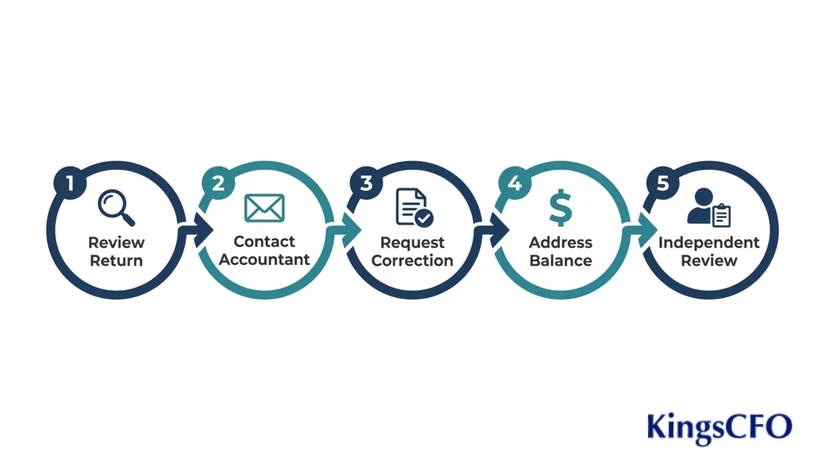
When your accountant makes a mistake, the right step depends on the error, whether the IRS has contacted you, and whether the mistake affects your tax. Use these five steps to lay out your response.
Step 1: Review The Filed Tax Return

You may be wondering, “I hired an accountant to review my tax how can I check the return myself?” All you need to do is, start comparing the filed return and your documents side by side and check that your name is spelled correctly and that your filing status is correct. Remember that you are not looking to audit the return, you only need to look for the gap between what you gave to the accountant and what the accountant filed.
Step 2: Contact The Accountant

The next step is to contact the accountant. Follow up with an email and mention that you want a written record of everything. When an accountant makes a mistake, a professional and reputable one will own it and move immediately to fix it. If the accountant owns up to the mistake, work together to fix the problem. If the accountant gets defensive, blames you or stops returning your calls, then you should send a written notice. And look for another replacement.
Step 3: Request a Corrected Return
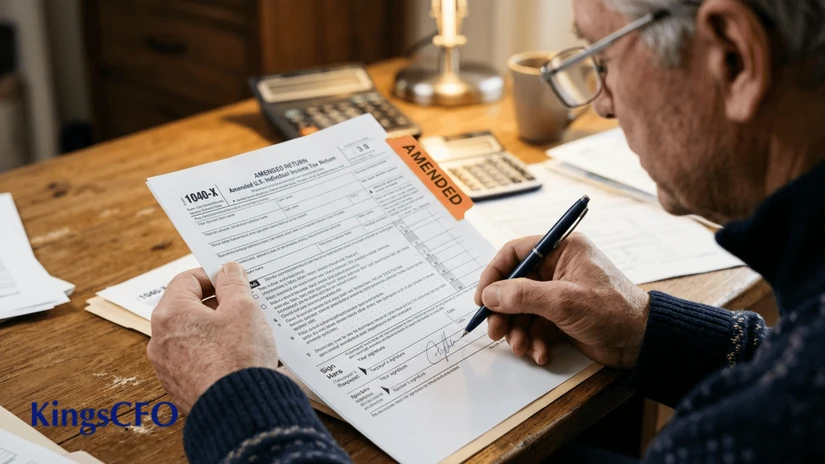
An amended return will be prepared by your accountant, and you will have to sign it. Make sure to read everything before signing, if you don’t understand, ask your accountant to explain it to you.
The IRS generally allows you to claim a refund via an amended return within three years from the date you filed the original return, or two years from the date you paid the tax. If your accountant makes a mistake through negligence, ask them to cover any interest and penalties and get that agreement in writing before the amended return is filed.
Step 4: Address Additional Tax or Interest

If there is a balance due of any additional tax or interest, you have to pay it, or set up an installment agreement. Unpaid balances can incur interest at the federal short-term rate plus 3%, compounded daily. Failure-to-pay penalty runs at 0.5% per month on the unpaid tax, up to 25%.
The IRS separates the tax from the penalty, which you almost certainly owe if the return was wrong.
Step 5: Hire a New Professional or Do an Independent Review

If your accountant makes a mistake and then becomes unresponsive, or you simply don’t trust them anymore, then you need to hire someone else to review the situation. An independent review can help identify additional errors, unsupported deductions or unreported income before you decide how to process. For a UAE business, a financial advisory service in Dubai can provide that second review.
How to File a Complaint Against a Bad Tax Preparer?

Be cautious if a tax preparer guarantees a particular refund, suggests deductions without reviewing your records, or refuses to explain how figures were calculated. These warning signs do not prove misconduct on their own, but they justify asking questions and checking the filed return.
What is Form 14157 and When to File It?
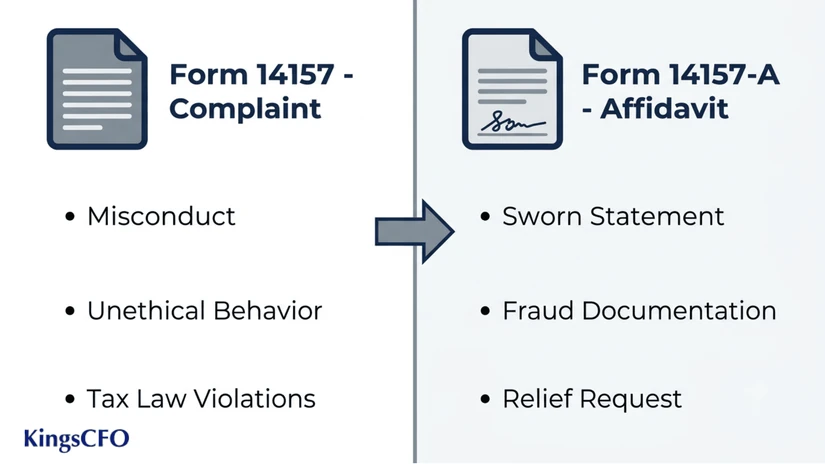
Form 14157 is a Return Preparer Complaint, it is an official Internal Revenue Service document used to file a complaint against a paid tax return preparer or tax preparation business that has violated ethical standards or tax laws.
You should file it when the preparer violates tax rules, mishandles your return, or acts dishonestly. If you find that the preparer has not filed the return, refused to give you a copy, changed information without permission, directed your refund to an account you do not own, charged improper fees or fabricated income, deductions, or credits, that is when you need to file a complaint against the tax preparer.
Filing Process (Form 14157 and 14157-A)
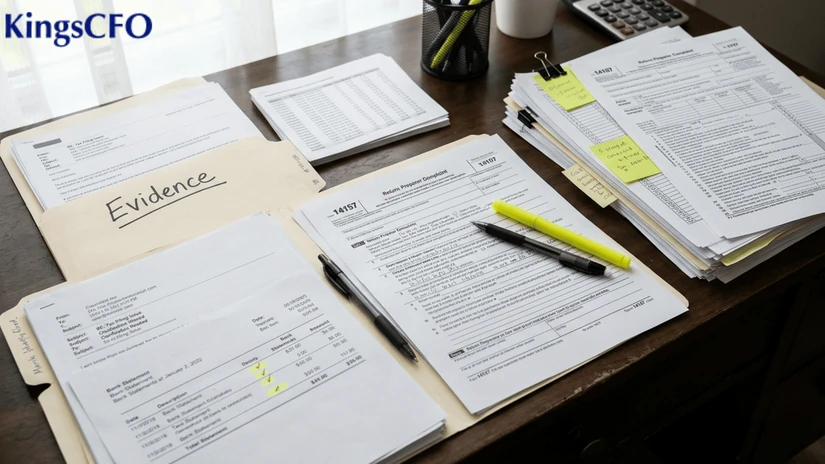
Here’s where most people get confused. You have to simply understand that Form 14157 is the complaint. Form 14157-A is the affidavit used to request a change to the taxpayer’s account in specified misconduct cases. The IRS decides whether to pursue the preparer, the taxpayer still has to correct the return and address the balance.
File Form 14157 when the preparer violated tax rules, refused to give you a copy of the return, changed information without permission, directed your refund to an account you did not own, or fabricated income, deductions, or credits. Attach emails, bank records, and a police report if the refund was stolen. But do not file it expecting the IRS to make you whole. File it because it is the correct record, and because the collection data shows the IRS is unlikely to recover the money on its own.
Who Actually Pays the Penalty?

You probably must be thinking you’re off the hook when your accountant makes a mistake, but here’s what you need to know and why you’re the one paying the penalties.
The Taxpayer
The IRS assesses penalties against the taxpayers whose name is on the return, since you have signed, the penalties and the IRS notice will come in your name. The IRS has a claim against you, not your accountant, because your relationship with the IRS is direct and your relationship with your accountant is a private contract.
The tax was always yours to pay, and even if a mistake caused you to underpay, the extra tax was owed all along. Correcting the error doesn’t create a new debt, it only reveals the real one. Penalties and interest are a cost of the delay, and the IRS charges them on the unpaid amount from the original due date, regardless of who caused the error.
The IRS assesses the penalty against the taxpayer because the taxpayers signed the return under the penalty of perjury. In the earlier stated study, the court excused the penalty because the taxpayer proved two things: he had supplied full and correct information to the accountant, and the error was solely the accountant’s mistake.
TIGTA reported that the IRS collected only 8% of penalties in its Business Performance Review for FY 2016. The Center for Taxpayer Rights found the overall collection rate on preparer penalties was 18.45%, ranging from 2.61% to 100% depending on the year and preparer type. The IRS does not function as the taxpayer’s collection agency against the accountant. The engagement letter and a written demand are the taxpayer’s real leverage.
Common Penalties You Could Face
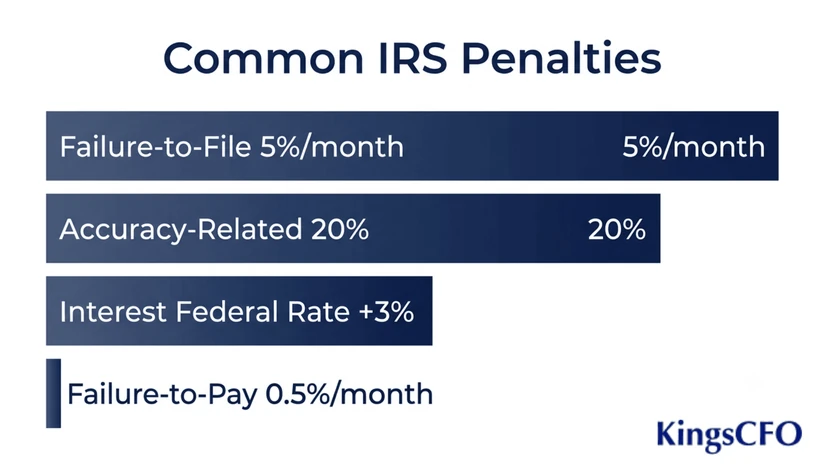
The most common penalties you could pay are listed below.
- Accuracy-related penalty: This is the penalty most often seen when an accountant makes a mistake, it generally equals 20% of the underpayment attributable to negligence or a substantial understatement of income tax. This happens when the IRS believes that you have failed to make a reasonable attempt to comply with the tax law.
- Failure-to-pay: This penalty is applied when tax is still unpaid after the due date, which happens when a mistake means you underpaid or never realized you owed. It is 0.5% of the unpaid tax per month, also capped at 25%. These are the penalties the taxpayer will see on the notice. The preparer penalty is a separate assessment, and the collection data above shows why it is not a reliable reimbursement route.
- Failure-to-file: This penalty leads to a late return, for example, because your accountant missed a deadline or filed an extension incorrectly, this penalty applies. It runs at 5% of the unpaid tax per month, up to a maximum of 25%. If both are paid in the same month, then the combined rate will remain 5% (4.5% late filing plus 0.5% late payment)
- Interest on Underpayments: Interest is not a penalty, but it gradually adds up. The IRS charges interest on unpaid balances, including on penalties, at the federal short-term rate plus 3 percent points, adjusted quarterly. The interest rate also changes quarterly, so use the current IRS rate page rather than a static figure that may be outdated.
The Accountant’s Liability

If your accountant makes a mistake and acknowledges it, you are in a much stronger position. Start with the engagement letter, many people say that the preparer will cover penalties and interest resulting from their errors. But here is what you need to understand, if your accountant takes accountability, send a written demand citing that clause. If they refuse to accept responsibility for their mistakes, the next step is to bring a claim in small claims court for amounts under your jurisdiction’s limit.
The US and UAE systems differ in their details, but the structural risk is the same, the person whose name is on the return bears the first assessment. In the UAE, late corporate tax registration carries a fixed AED 10,000 penalty. If an error is corrected before an FTA audit, the penalty is 1% of the tax difference per month from the original due date. If your business wants support with these deadlines, see our corporate tax service in Dubai.
Before hiring a replacement, compare the scope of the professional’s responsibilities with the services your business actually needs. KingsCFO’s accounting service in Dubai explains the support available to UAE businesses.
Also, one more thing, the IRS can also penalize the preparer directly for certain conduct, including failing to sign a return or failing to provide a copy to the taxpayer.
The Bottom Line
If your accountant makes a mistake on your tax return, act promptly. Review the IRS notice, document the error, correct the return if required, and assess any additional tax, interest or penalties separately. If the mistake resulted from professional negligence, review your agreement and consider seeking reimbursement. Do not assume that correcting the return automatically resolves every issue.
KingsCFO works with UAE SMEs on the compliance calendar and the documentation trail that makes a voluntary disclosure possible before the FTA finds the error first. Depending on your size, that support can come through a virtual CFO service in Dubai or a full CFO service in Dubai. The goal is not to promise that mistakes will never happen. It is to make sure the business controls the sequence which is to identify the error, correct it, and document who was responsible before the penalty regime escalates.
Ready to build a more reliable financial foundation? Contact KingsCFO today to discuss your business’s financial needs.
FAQs
Can I get a refund of my preparer’s fee if they make a mistake?
Not automatically. You need to check your engagement letter first because many preparers fix their own errors first. If they refuse, send a written demand and report them to the IRS.
How long do I have to fix a tax return error?
Three years from the filing date or two years from payment.
Will I be audited because my accountant makes a mistake?
No, the errors can raise red flags if they create mismatches or unusual deductions, but audits are often random.
Is my accountant responsible if the IRS charges me penalties?
Even when your accountant makes a mistake, the IRS bills you first because you signed the return. Seek reimbursement from the accountant if the penalty came from their negligence, and then you can request penalty abatement from the IRS.

Mayur Bardoloi is a content writer with more than four years of experience across writing and proofreading. His content for KingsCFO explains financial topics and CFO services for business owners who may not have a finance background.