
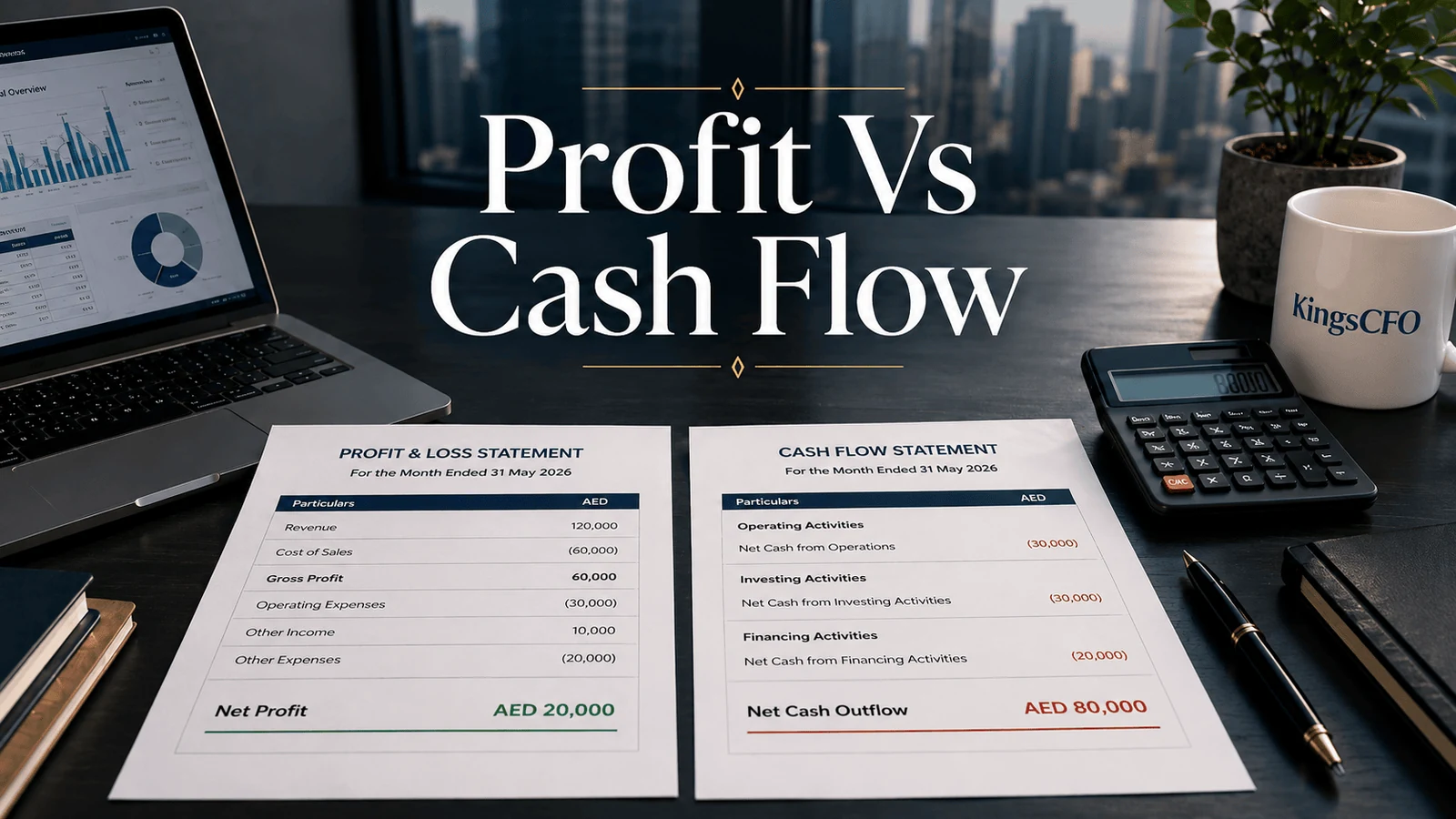
Profit vs Cash Flow: Why a Profitable Business Can Still Run Short of Cash
Your profit and loss statement reports a healthy result, yet the bank balance still makes you pause before payroll, supplier payments, tax, or a planned hire. This profit vs cash flow gap can make both reports feel unreliable. If the business made a profit, why is so little available?
Many explanations add to the confusion by defining both terms without showing why a completed sale can increase profit before the customer pays, or why growth can strengthen the P&L while reducing usable cash.
When I discussed this gap with our in-house CFO, he focused on the timing of money entering and leaving the business. Profit records the financial result produced over a period. Cash flow shows the money available after receipts and payments have taken place.
Keep reading to follow one AED 100,000 sale from completion to payment, understand what separates cash flow and profit, and identify what to review before approving your next commitment.
Profit vs Cash Flow in One Minute
Profit is the amount remaining after revenue and expenses are recorded for a reporting period. Cash flow tracks the money that actually entered or left the business during that period. Customer-payment delays, inventory, equipment purchases, loans, and debt repayments can therefore make profit and available cash move differently.
Profit vs Cash Flow: What Each Number Shows
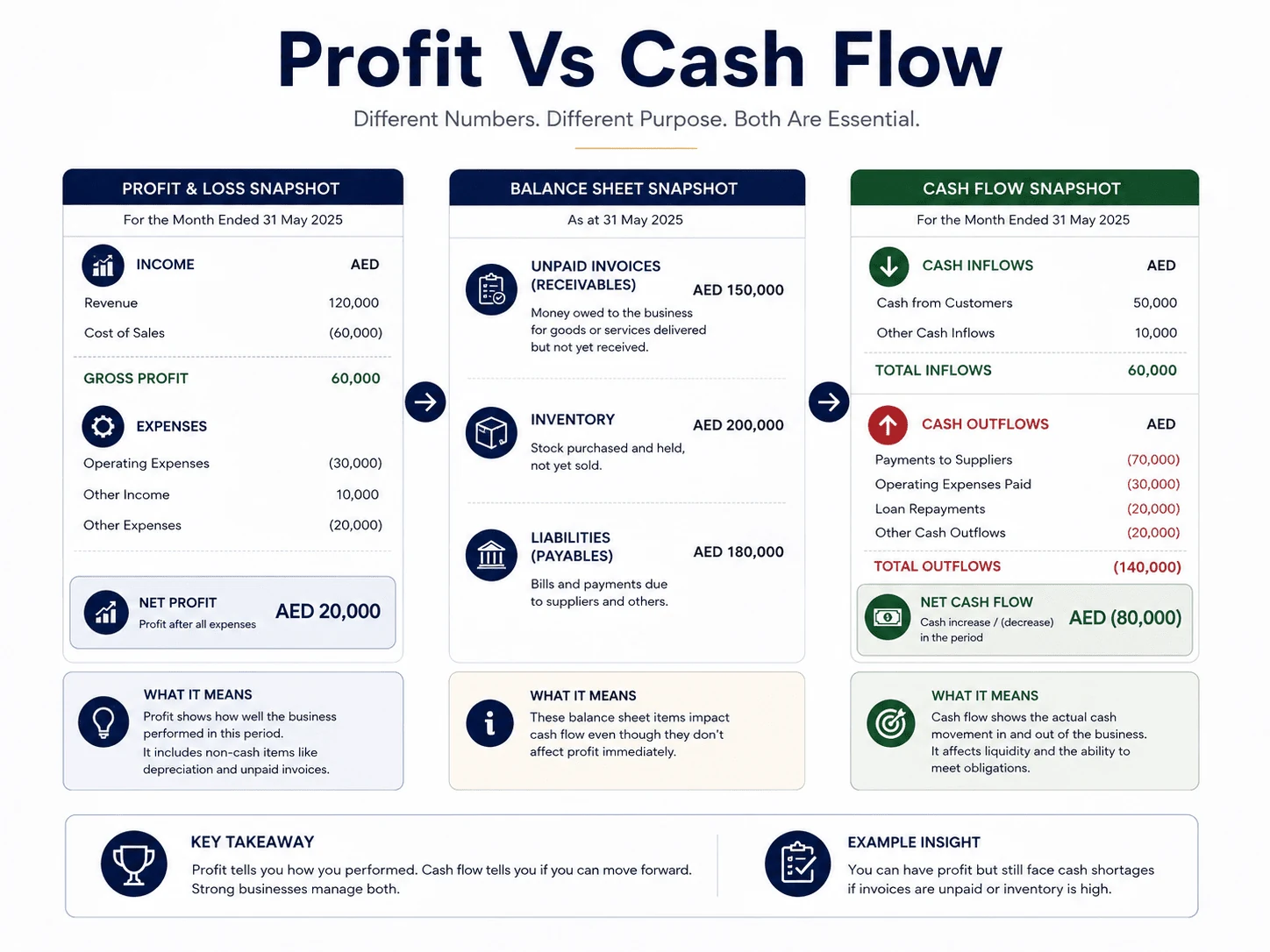
Profit appears on the profit and loss statement, also called the P&L or income statement. It shows the financial result after the business records its revenue and related expenses for a month, quarter or year.
“Recorded” or “recognised” means included in the accounts for that period. The cash connected with the transaction may move earlier or later.
Cash flow records money entering and leaving the company. It helps management assess liquidity, which means the ability to pay wages, suppliers, tax, debt and other commitments when they become due.
The US Securities and Exchange Commission’s guide to financial statements explains that an income statement reports revenue and expenses over a period, while a cash flow statement records cash exchanged with the outside world. It also divides cash movement into operating, investing and financing activities.
| Question | Profit | Cash flow |
|---|---|---|
| What does it measure? | Revenue minus recorded expenses | Cash received minus cash paid |
| Where is it reported? | Profit and loss statement | Cash flow statement |
| What does it help assess? | Profitability | Liquidity |
| Can an unpaid invoice affect it? | Yes, after the revenue is earned and recorded | No cash arrives until the customer pays |
| Can borrowing increase it? | No | Yes |
| Can depreciation affect it? | Yes | It does not create a new monthly cash payment |
The balance sheet shows where money may currently be tied up through unpaid invoices, inventory or other assets. It also records liabilities the company still needs to settle.
Compare the P&L and cash flow statement for the same reporting period. Using figures from different months can create an apparent gap before the underlying transactions have even been examined.
Historical statements explain completed activity. Forward-looking CFO guidance can connect those results with expected receipts, upcoming payments, and decisions that may absorb cash.
Cash Flow vs Profit in One AED 100,000 Sale
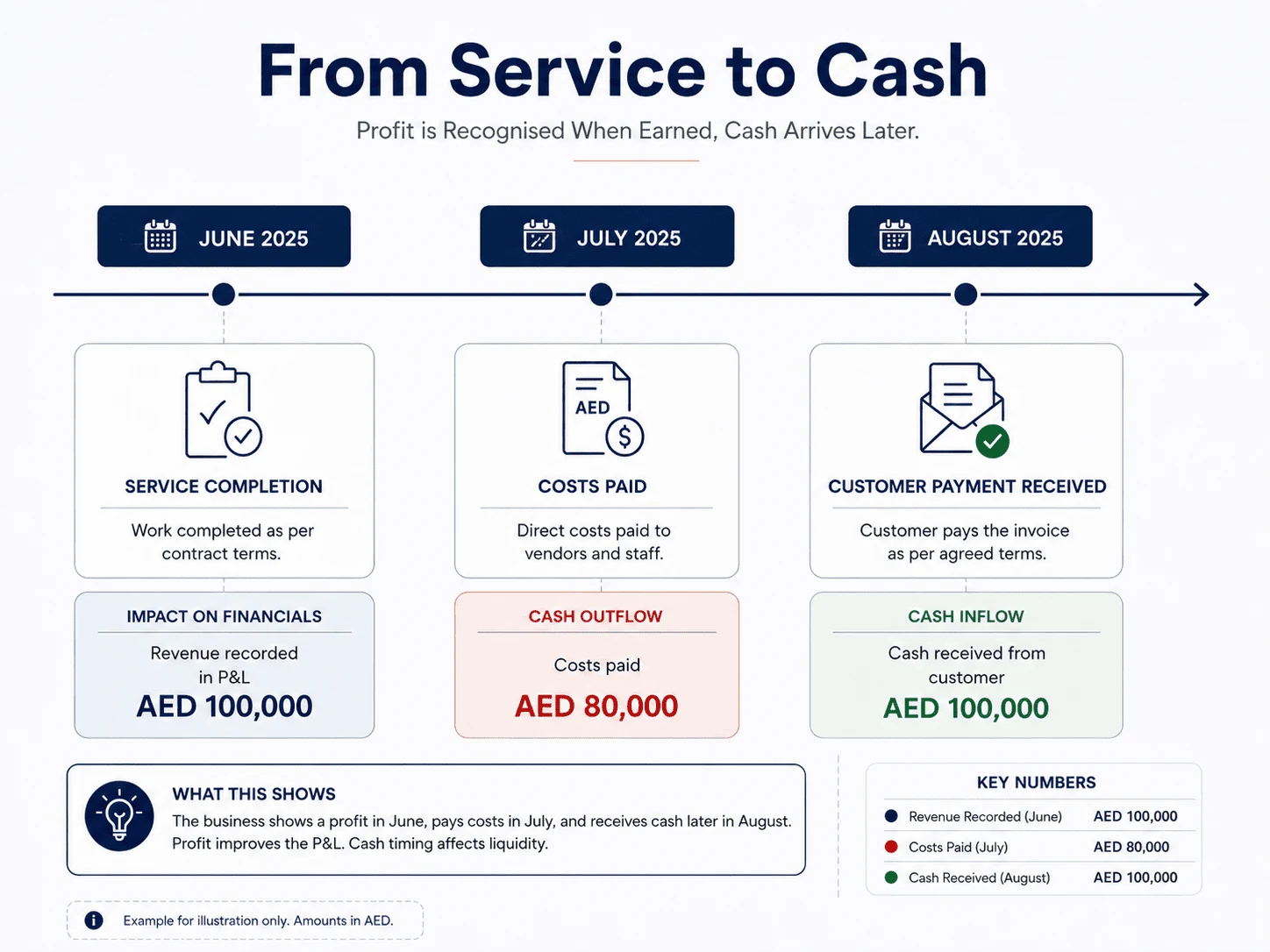
A professional-services firm completes its contractual service obligation in June and invoices the customer AED 100,000. The payment terms give the customer 60 days to settle the invoice.
The firm records AED 100,000 as June revenue because the agreed service has been delivered. IFRS 15 Revenue from Contracts with Customers links revenue recognition to the transfer of promised goods or services to the customer, although the precise treatment depends on the contract and surrounding facts.
The firm also records and pays AED 80,000 in project and operating costs during June.
| June P&L | Amount |
|---|---|
| Revenue recorded | AED 100,000 |
| Expenses recorded | AED 80,000 |
| Net profit | AED 20,000 |
The customer has not transferred any money by the end of June.
| June cash movement | Amount |
|---|---|
| Customer payment received | AED 0 |
| Project and operating costs paid | AED 80,000 |
| Net cash movement | -AED 80,000 |
The project produced an AED 20,000 profit, while the firm funded AED 80,000 of costs from its existing cash. The profit belongs to June because the service was delivered then. The cash arrives in August when the customer pays.
Once the AED 100,000 enters the bank account, the outstanding invoice is removed from accounts receivable. The firm does not record the same revenue again in August.
Larger contracts can make the interval between delivery and collection harder to carry because staff, suppliers and operating costs may need funding before the first customer receipt arrives.
Choose one recent invoice and note when the work was completed, when its costs were paid and when the customer settled it. These dates may account for much of the difference between reported profit and the bank balance.
Difference Between Profit and Cash Flow: Six Events to Check in Your Own Accounts
“Cash is a fact, profit is an opinion.” The line comes from Alfred Rappaport, the Kellogg School of Management professor known for his book Creating Shareholder Value. His point still holds. Profit is shaped by accounting judgment, while cash movement can be tracked and verified.
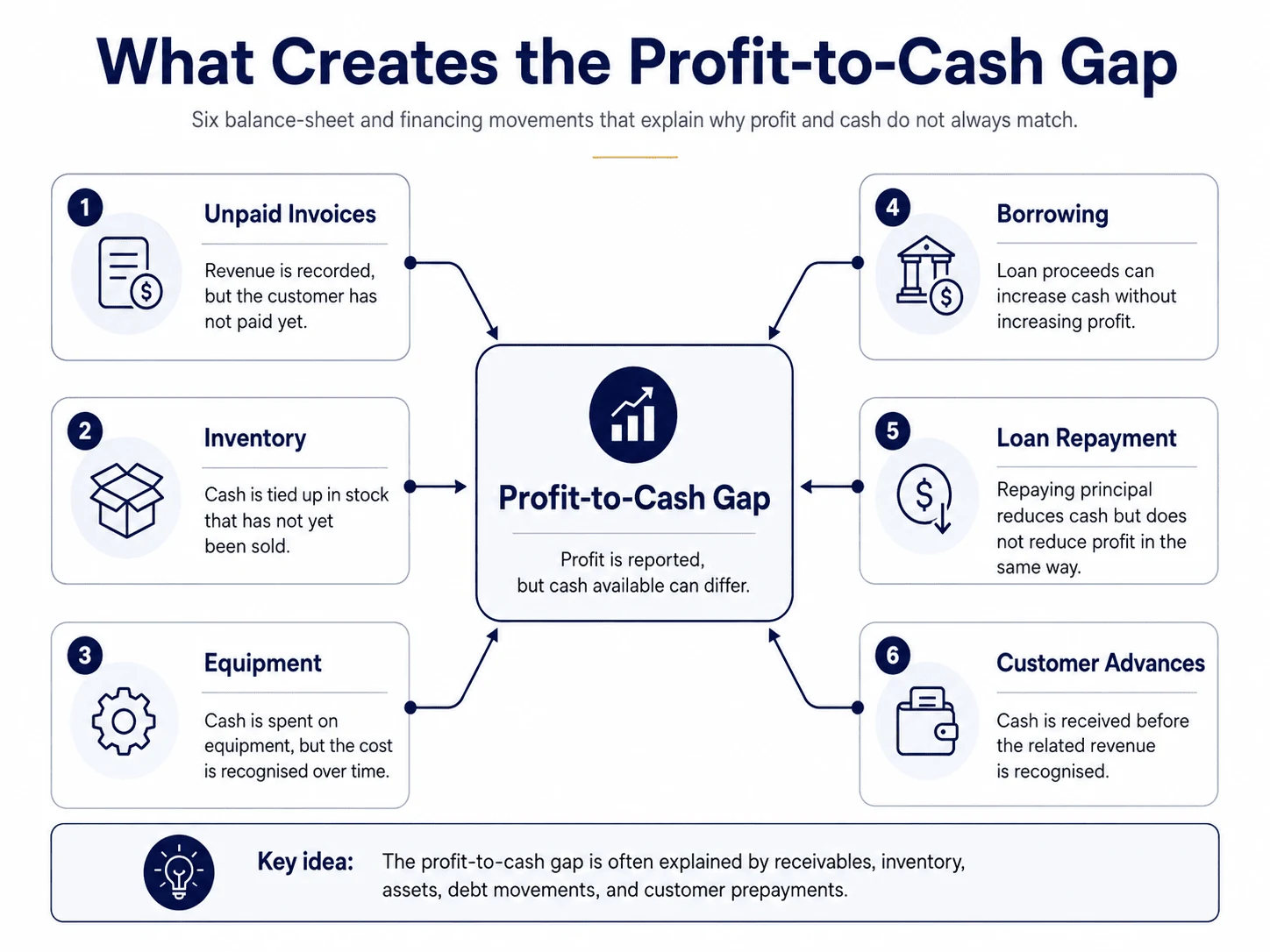
The six events below show where that judgment opens the widest gap between the two figures.
Unpaid Invoices Increase Profit Before Cash Arrives
After a business delivers the agreed product or service, it may record the revenue while the invoice remains unpaid. The outstanding amount appears in accounts receivable, which records money customers owe the company.
The business cannot use that amount until the customer pays. Compare current receivables with the previous three months and identify invoices that have passed their agreed payment dates. ACCA’s guidance for chartered accountants names a growing receivables balance as one of the clearest signs that profit is running ahead of cash, since it means revenue is recorded before the money behind it has arrived.
Inventory Can Absorb Cash Before It Becomes an Expense
A retailer purchases AED 150,000 of stock. Cash falls when the supplier is paid, while unsold products remain on the balance sheet as inventory.
The cost reaches the P&L as customers buy the products. Until then, money remains tied up in stock rather than being available for rent, salaries, or further orders.
Check whether inventory is growing faster than sales. That pattern may indicate that more cash is being committed to products that have not yet generated a return.
Equipment Reduces Cash Faster Than Net Profit
A company pays AED 120,000 for equipment it expects to use for several years. The entire payment leaves the bank at once.
The P&L normally reflects the cost gradually through depreciation, which allocates the asset’s cost across the periods in which it is used.
Review major equipment, vehicle, software and premises purchases separately when cash falls more sharply than net profit.
Borrowing Can Create Positive Cash Flow Without Profit
A business records an AED 30,000 operating loss and receives AED 250,000 from a new bank loan. The bank balance rises, but the borrowed money is financing rather than customer revenue.
The company remains loss-making despite the positive cash movement. Separate operating, investing and financing cash flows to identify where the additional money came from.
Loan Principal Reduces Cash Without Reducing Operating Profit
Interest is the cost of borrowing and generally appears as an expense. Principal repays the original loan balance, reducing cash and the amount owed without becoming a routine operating expense.
Ask the finance team to separate interest and principal in the repayment schedule. Looking only at the combined instalment can hide why profit and cash changed by different amounts.
Customer Advances Increase Cash Before Revenue Is Earned
An events company receives AED 80,000 three months before an event. Cash enters the bank, but the company still owes the customer the promised service and must fund the delivery costs.
Using the full deposit elsewhere could leave insufficient money for the event. Match advance payments with the work and costs they are expected to fund.
When several of these movements occur together, P&L and cash flow modelling can show how working capital, assets and debt may affect the following months. Working capital is the short-term money tied up in customer invoices, inventory and supplier payments.
Net Profit vs Cash Flow: Why Growth Can Tighten Cash
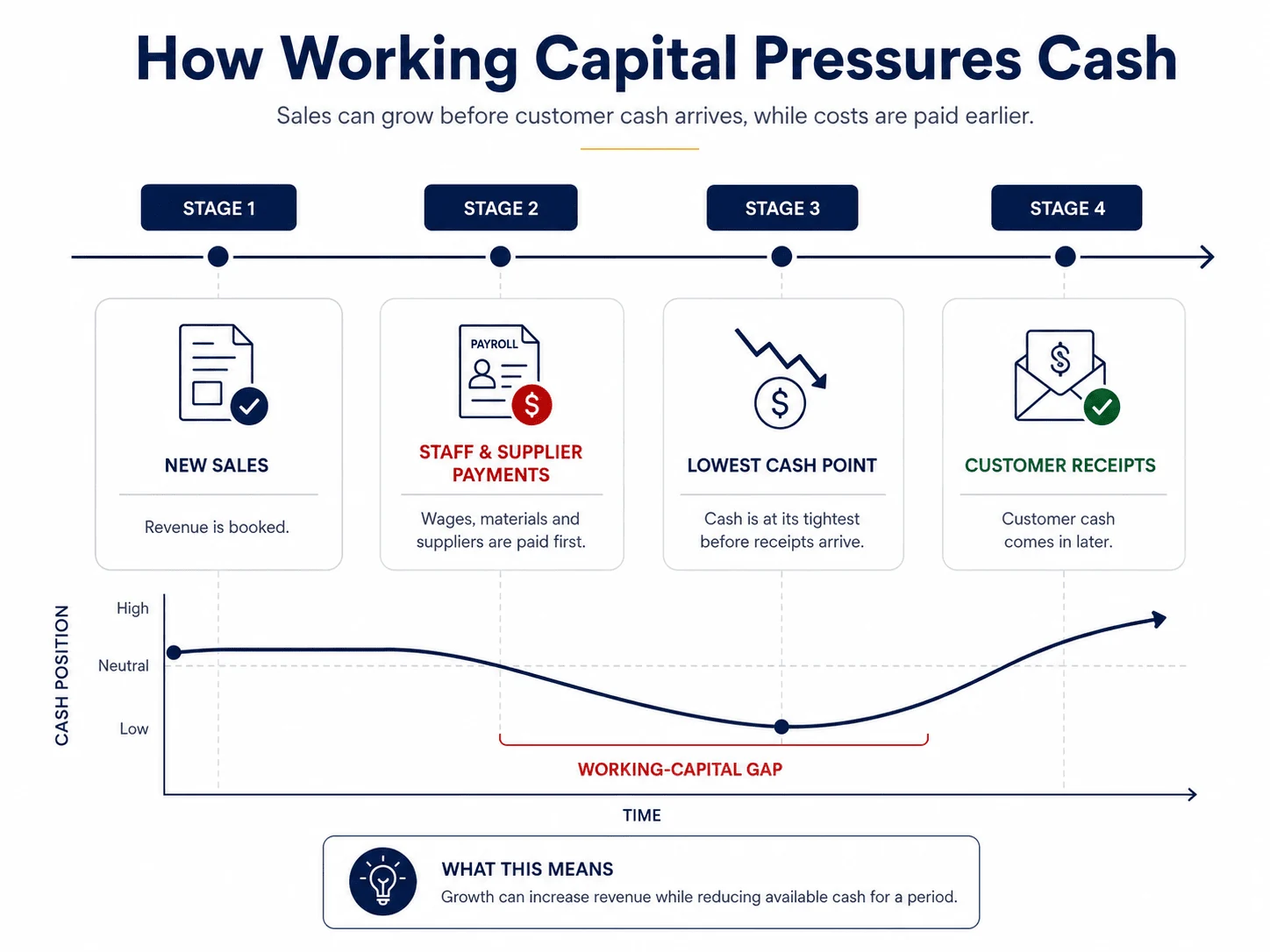
A profitable company can run short of cash when growth requires payments before customer receipts arrive.
New contracts expected to produce AED 200,000 in revenue may require AED 75,000 for recruitment, suppliers, and delivery. The business must fund those commitments while the work is completed and the invoices remain within their payment terms.
“Growth sucks cash,” Verne Harnish writes in Scaling Up, calling it the first law of entrepreneurial gravity. Rising payroll, supplier costs, and delivery timelines squeeze a business even as revenue climbs. The AED 200,000 contract above follows that pattern. The revenue lands on the P&L before the AED 75,000 in delivery costs is recovered.
Accounts receivable may rise alongside revenue and profit, while available cash declines. This condition is sometimes called overtrading, which means the company is expanding faster than its current cash resources can support.
Our experts review cash runway in this situation because it can estimate how long the business can continue meeting expected payments using the money currently available.
In a 2016 JPMorgan Chase Institute report, Diana Farrell and Chris Wheat analysed more than 470 million transactions from 597,000 small businesses. The median business held enough cash to cover 27 days of typical outflows. The data covered February to October 2015, so the result offers historical context rather than a reserve target for every company.
Estimate the current buffer by dividing available cash by average daily cash outflows. Repeat the calculation after moving a large expected receipt 15 or 30 days later to see how a collection delay would affect the company.
Using Profit and Cash Flow Before a Major Decision
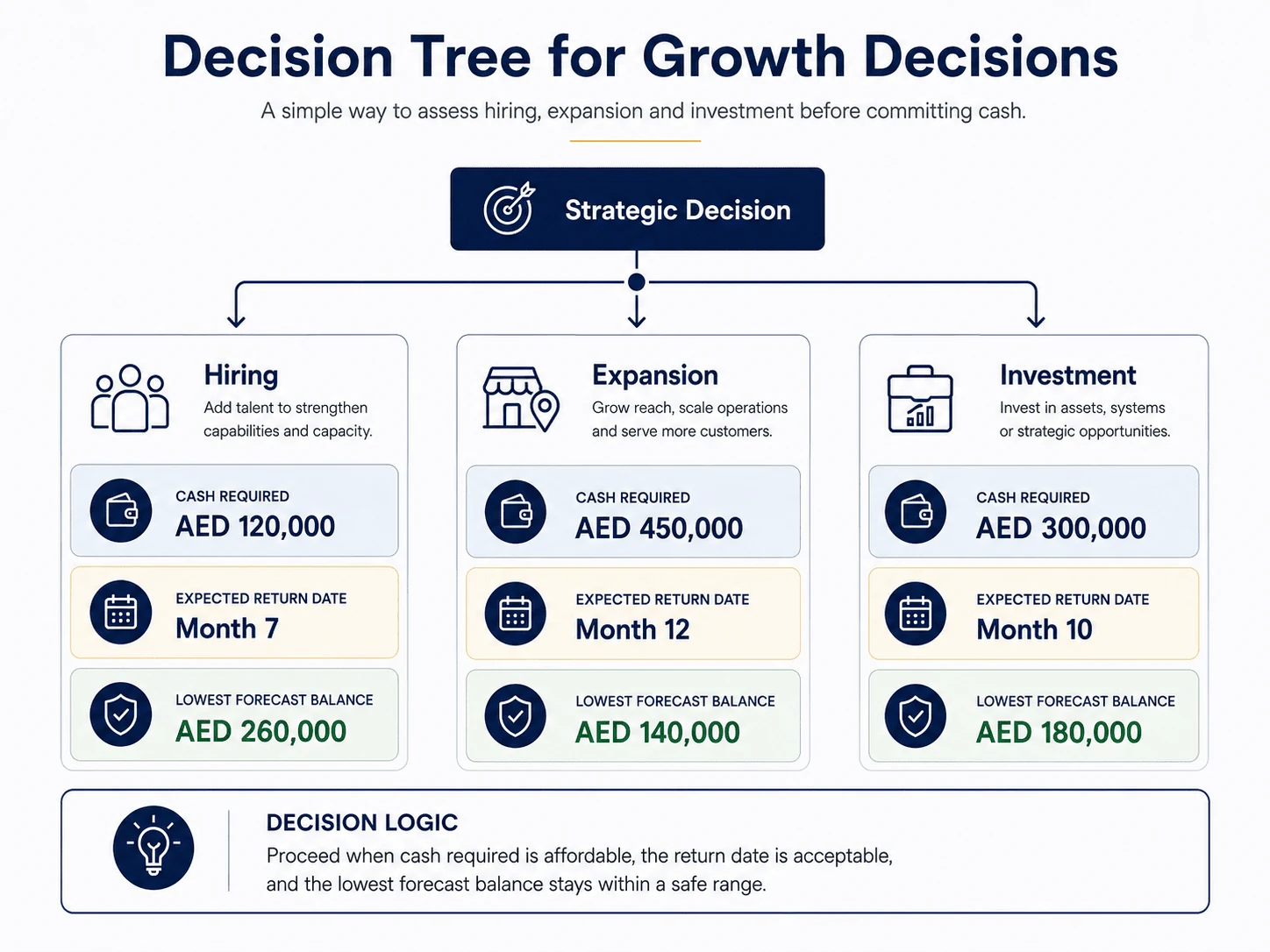
Hiring, expansion, and investment create payments before they produce a return. Management needs to know how much cash a decision will absorb, when the expected receipts may arrive, and how existing commitments will be met if the return is delayed.
Profit helps assess if the activity can produce an adequate financial return. The cash forecast reveals when the related payments will be due and when the expected receipts may arrive.
Our CFO suggests reviewing available cash, runway, expected profit and the assumptions supporting the forecast before advising on a major commitment.
| Decision | Examine first | Confirm next |
|---|---|---|
| Can payroll be met next week? | Available cash | Expected customer receipts |
| Is the pricing commercially viable? | Profit margin and net profit | Cash generated from those sales |
| Can another employee be hired? | Forecast cash commitments | Revenue expected from added capacity |
| Can the business expand? | Cash runway | Demand evidence and expected profit |
| Can the owner withdraw money? | Cash after upcoming obligations | Retained profit and tax liabilities |
| Is borrowing supporting growth or losses? | Operating and financing cash flows | Profit and margin trends |
A decision may produce a profit over time but require more money than the company can commit at the beginning. Financial services for monthly visibility and decision support can connect current reports with forecasts before expenditure is approved.
Record the payment required at each stage, the expected return date, and the lowest projected cash balance between those points.
“The first warning may appear in day-to-day operations instead of monthly financial reports.”
Santosh Kumar, KingsCFO
Operational Changes That Can Affect Future Cash Flow
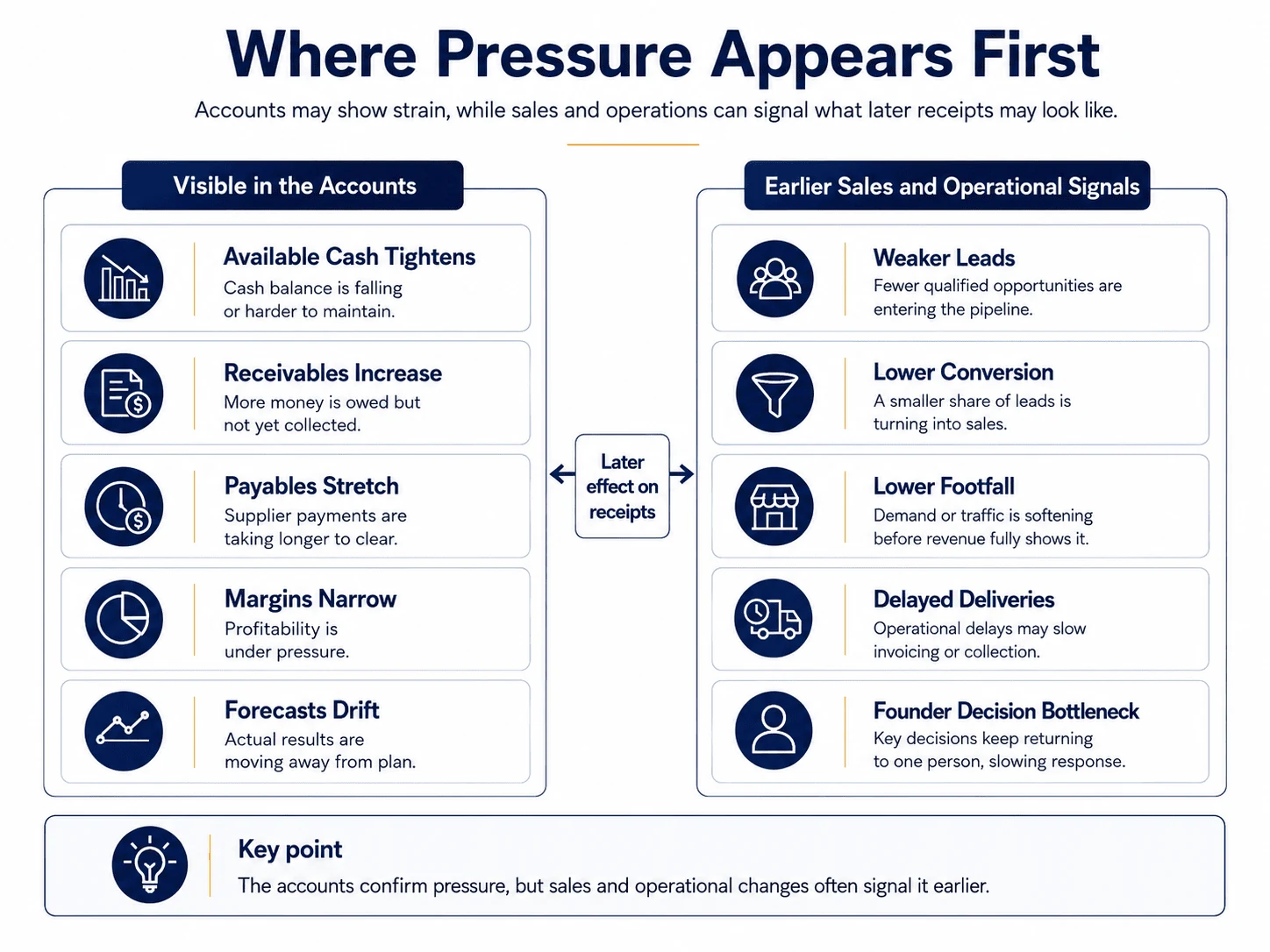
A decline in qualified leads reduces the number of potential customers entering the sales process. Falling conversion means fewer prospects become paying customers, while missed sales targets may reduce expected receipts in the coming months.
Delivery problems create a different pressure. Supply-chain delays can postpone project completion and invoicing, even as salaries, supplier payments, and other operating costs continue.
| Financial Report Symptom | Operational Check to Run |
|---|---|
| Pressure visible in the accounts | Operational change that may affect future cash |
| Profit rises while the bank balance falls | Qualified leads decline |
| Receivables grow faster than revenue | Sales conversion weakens |
| Customers regularly pay late | Enquiries or footfall fall |
| Inventory increases faster than sales | Sales targets are missed |
| Routine costs depend on borrowing | Expenses rise before revenue responds |
| Supplier or tax payments are delayed | Logistics problems postpone delivery |
These operational changes do not guarantee a cash shortage but simply show that your initial cash forecast assumptions are now outdated. This early warning gives management time to delay spending or secure credit before an actual deficit happens. You just need to revise your forecast to match current conditions.
Review daily sales and delivery metrics alongside your financial reports to see a clear picture of future liquidity, and update your expected collection dates and expenses whenever your daily operations change.
How to Review Profit and Cash Flow Each Month
- Record net profit for the period. Identify the revenue and expenses that produced it.
- Compare it with operating cash flow. This covers cash generated or used by normal business activity.
- Review unpaid invoices. An accounts-receivable ageing report shows how long each invoice has remained outstanding. It is also one of the first lists an auditor asks for, as our financial audit checklist explains.
- Check inventory and supplier obligations. Identify where cash is already committed.
- Separate the sources of cash. Investing cash flow covers long-term asset purchases and sales. Financing cash flow includes borrowing, owner funding and repayments.
- Calculate cash runway. Compare available cash with payments expected over the coming months.
- Use realistic collection dates. An invoice date does not guarantee that the money will arrive on schedule.
- Update operational assumptions. Adjust future revenue and costs when leads, conversion, delivery capacity or supplier performance changes.
At KingsCFO, our finance experts review the source and timing of cash rather than relying on the closing bank balance alone.
Finish with net profit, operating cash movement and the lowest forecast cash balance. Together, they show the result produced, the cash generated by normal operations and the period in which financial pressure may be greatest.
What Profit and Cash Flow Reveal Before the Next Decision
Profit records the financial result produced during a reporting period. Cash flow records when money entered or left the business.
The figures may separate because of unpaid invoices, inventory, equipment purchases, loan repayments, borrowing or customer advances. Comparing both reports for the same period shows where money is tied up and when it may move.
Before approving another hire, investment or expansion, review net profit, operating cash movement and the lowest forecast cash balance together. Then trace any material difference to customer payments, inventory, assets, debt or financing activity.
When the same pressure keeps returning, a KingsCFO financial risk assessment can examine the company’s financial structure, test the assumptions inside its forecast and identify the cash-flow risks affecting the next commitment.
FAQs
Is cash flow the same as profit?
No, profit is revenue minus recorded expenses for a period. Cash flow records money that entered or left the company. Payment timing, inventory, equipment, borrowing, and debt repayment can cause the figures to move differently.
What is the difference between profit and cash flow?
Profit measures the financial result produced during a reporting period. Cash flow tracks the movement of money. A company may record revenue before receiving payment or spend cash on an asset whose cost reaches profit gradually.
Why can net profit be higher than cash flow?
Net profit may be higher when customers have not paid, cash has been used for inventory or equipment, or loan principal has been repaid. These events reduce available cash without creating an equal expense in the same period.
Can cash flow be positive when a business makes a loss?
Yes, borrowing, owner funding, an asset sale or a customer advance can increase cash while the company remains unprofitable. Review operating, investing and financing cash flows separately to identify the source.
What is profit and loss vs cash flow?
A profit and loss statement records revenue, expenses and the resulting profit or loss. A cash flow statement records money moving through operating, investing and financing activities during the same period.
Which matters more, cash flow or profit?
Both are necessary. Profit shows whether business activity produces a financial return. Cash flow shows the money received and paid during the period and the amount remaining after those movements.
Have a question about your own numbers? Get in touch with the KingsCFO team.