Your free zone company just invoiced an overseas client, and you need to know how that payment affects your tax bill. Does the income qualify for 0%? And if you expect to owe nothing, do you still need to file a return?
Timing matters under Corporate Tax UAE Free Zone rules. The Federal Tax Authority generally gives companies nine months from the end of their tax period to file their return and pay any corporate tax due. You want to use that time to check your figures and gather the paperwork, so you know what to set aside before the deadline gets close.
When I compared the FTA guidance with the invoice checks KingsCFO’s tax team described, one detail stood out. An invoice can show who paid you while leaving open who actually received the service. That’s why the checks in this guide start with what you sold and who received it.
Keep reading as in this Corporate Tax UAE Free Zone guide, I’ll walk you through mainland and overseas sales, the de minimis calculation, and the records your company needs before filing.
Corporate Tax UAE Free Zone Rates at a Glance
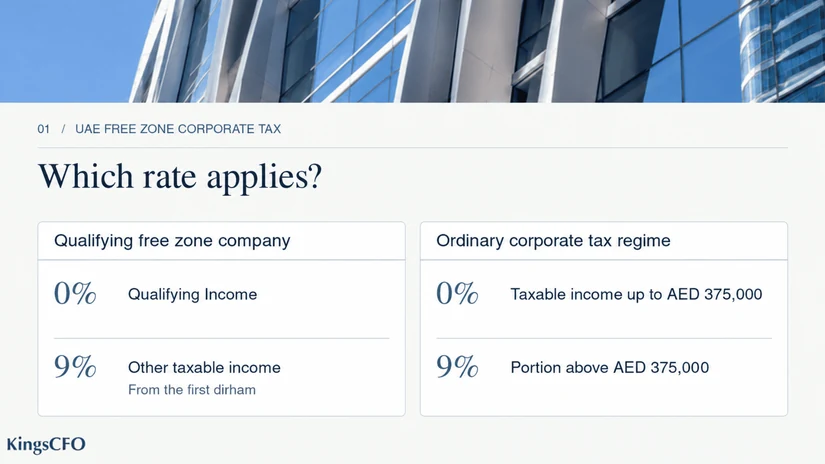
A qualifying free zone company pays 0% corporate tax on Qualifying Income and 9% on taxable income outside Qualifying Income. A free zone company generally still needs to register and file a return even if it owes no tax.
| Your company’s position | How the rate works |
|---|---|
| Qualifying Free Zone Company earning Qualifying Income | The 0% rate applies to Qualifying Income. |
| Qualifying Free Zone Company with other taxable income | The 9% rate applies to that taxable income from the first dirham. |
| Free Zone Company under the ordinary corporate tax regime | The ordinary rates are 0% on taxable income up to AED 375,000 and 9% on the portion above that amount. |
Check which regime your company uses before applying the AED 375,000 threshold. If you’re unsure about your status, KingsCFO offers corporate tax support for free zone companies.
Can Your Free Zone Company Use the 0% Rate?
Corporate Tax UAE Free Zone relief depends on your company’s status. Start with the company named on your trade licence. The law uses Free Zone Person for a legal entity incorporated, established, or otherwise registered in a free zone, and the definition can also cover branches. A company that meets the conditions for the preferential tax regime has Qualifying Free Zone Person status, usually shortened to QFZP status. We’ll refer to these businesses as qualifying free zone companies throughout this guide.
The eligibility conditions come from Article 18 of the Corporate Tax Law and the related decisions.
- Adequate substance. Carry out the core work that earns the income in the relevant zone and have the people, assets, and operating spend to support it. The facts of your business determine what is adequate.
- Qualifying Income. Identify the income that can qualify and check your non-qualifying revenue against the de minimis limit.
- Transfer pricing. Use terms that independent businesses would agree to when dealing with related parties, and keep the documentation the rules require.
- Audited financial statements. Prepare and maintain them as required for a qualifying free zone company under Ministerial Decision No. 84 of 2025.
- Tax election. Check that the company has made no election to use the ordinary corporate tax regime.
Paperwork drives every Corporate Tax UAE Free Zone review. Pull out your trade licence, activity list, and latest accounts. If the activity on your licence differs from the work in your contracts, flag the difference for review. You can also check KingsCFO’s free zone setup and licence activity guidance.
Corporate Tax UAE Free Zone Rules for Mainland and Overseas Sales
Each sale needs its own Corporate Tax UAE Free Zone check. The customer’s address is only one part of a UAE free zone corporate tax review. Article 3 of Cabinet Decision No. 100 of 2023 also looks at what your company supplied and, for certain transactions, who had the right to use the goods or services.
| Who you sell to | What to check |
|---|---|
| Another Free Zone Company | Check that the customer is the Beneficial Recipient and that the sale comes from an activity outside the Excluded Activities list. The customer must have the right to use and enjoy what you supplied, without a legal or contractual duty to pass it on to someone else. |
| A mainland company | Check if the income comes from a Qualifying Activity and if any exclusion applies. Ordinary consulting, for example, does not become a Qualifying Activity simply because the customer is a company. |
| An overseas company | If the customer is a Non-Free Zone Person, apply the activity test. The overseas address alone is insufficient to determine the rate. |
| An individual | Transactions with natural persons generally fall under Excluded Activities. Check the specific exceptions in the ministerial decision. |
When the Company Paying You Is Acting for Someone Else

When I asked the KingsCFO team what they check on a free zone invoice, they described a studio that bills a free zone company to design its CEO’s private villa. In that case, the project brief and contract help establish who could use the designs.
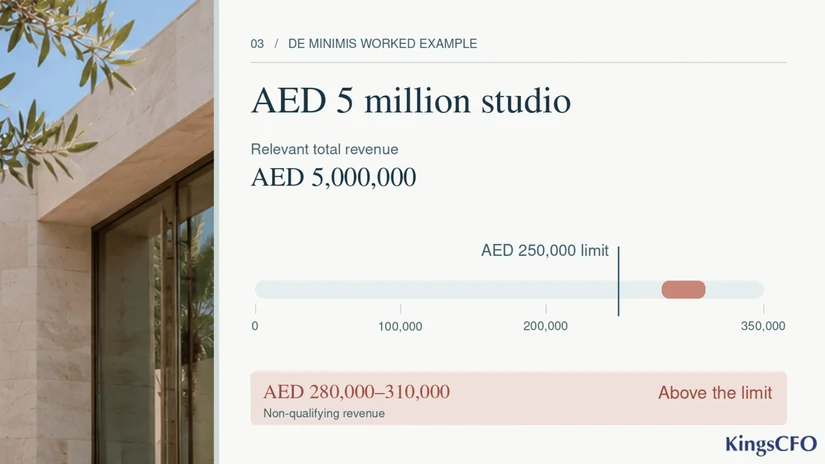
If the company acts only as an intermediary, the studio counts that revenue as non-qualifying for the de minimis test under the facts of this example. For example, let’s say the studio has AED 5 million in revenue that counts towards the test. Its limit would be AED 250,000, so finding AED 280,000 to AED 310,000 in non-qualifying revenue across its project files would put it over the limit.
The team also checks the customer’s legal form because a sole establishment and its owner count as the same person for corporate tax purposes, even when the establishment trades under a business name.
This is a practical Corporate Tax UAE Free Zone test. Try the same check on three recent invoices. Record what you supplied, the customer’s legal form, and the contract or other record that supports your classification. If those details sit in different places, monthly bookkeeping and reconciliation can help bring them together.
Which Business Activities Qualify Under the Current Rules?
The current list of Qualifying Activities for UAE free zone corporate tax comes from Ministerial Decision No. 229 of 2025. It replaced Decision No. 265 of 2023 and took effect from 1 June 2023. It expressly includes treasury and financing services for the company’s own account, subject to the conditions that apply.
| Business area | Activities the decision lists |
|---|---|
| Goods and trade | Manufacturing and processing goods or materials, trading qualifying commodities, and distributing goods or materials in or from a Designated Zone |
| Transport and logistics | Owning, managing, and operating ships, financing and leasing aircraft, and providing logistics services |
| Investment and regulated services | Holding shares and other securities for investment, reinsurance, fund management, and wealth and investment management |
| Group and treasury functions | Headquarters services to related parties and treasury and financing services for related parties or the company’s own account |
The Corporate Tax UAE Free Zone activity list has limits. Some closely connected support activities can also qualify. The decision separately lists exclusions, including banking, certain insurance and financing activities, many transactions with natural persons, and specified real estate activities. Check the definition and any exceptions that apply to the work your company actually does.
When Distribution Needs a Designated Zone

The 2026 OECD review led by Hélène François Georgieff reported that the UAE has more than 40 free zones. For a distributor, the question is more specific. Confirm that the operation runs in or from a Designated Zone for the relevant corporate tax rules.
Say you sell office furniture from a Designated Zone to a retailer that will resell it. That sale can meet the customer-use condition for qualifying distribution if you also meet the other requirements. If you sell the same furniture to an office that will use it, the usual resale condition is missing. The decision also allows supplies to qualifying public benefit entities under its terms.
Distribution is a common Corporate Tax UAE Free Zone question. Before classifying a distribution sale, check the zone, how any goods entering the UAE came in, and what the contract says the customer will do with them.
How Much Non-Qualifying Revenue Can You Earn?
The de minimis test for UAE free zone corporate tax limits how much non-qualifying revenue your company can earn while keeping its qualifying status. Use the lower of 5% of relevant total revenue or AED 5 million for the tax period.
Every Corporate Tax UAE Free Zone de minimis check begins with the same figure. Start with revenue. Article 4 of Cabinet Decision No. 100 of 2023 tells you which amounts to leave out of both sides of the calculation, including revenue attributable to certain branches or other permanent establishments, specified free zone property revenue, and certain IP revenue. If you’re pulling figures from your accounts, first check the difference between revenue and profit.
An AED 2 Million Studio Near the Limit
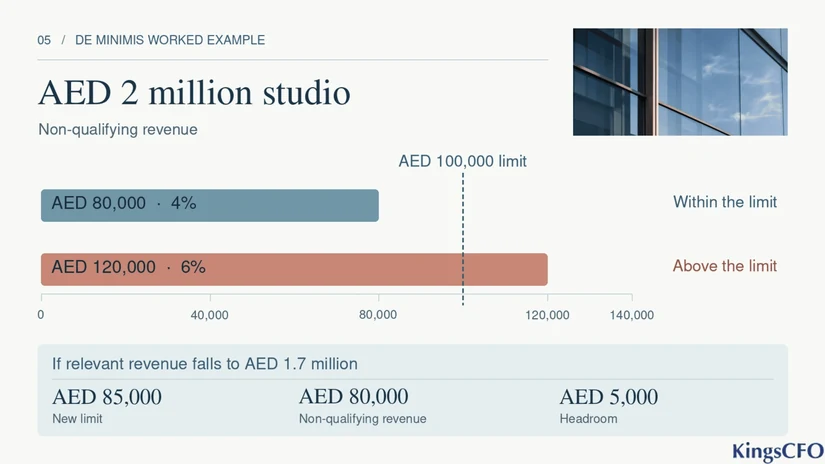
Suppose a free zone design studio has AED 2 million of relevant total revenue. Its other income qualifies, it meets the remaining conditions for qualifying status, and it has no branch, property, or IP amounts that require separate treatment in this example. At 5%, its limit is AED 100,000.
| Non-qualifying revenue | Share of relevant total revenue | Result |
|---|---|---|
| AED 80,000 | 4% | Passes the revenue test with AED 20,000 of room left. Article 3(1)(d) allows eligible other income to qualify when the test is met. |
| AED 120,000 | 6% | Exceeds the limit by AED 20,000 and fails the revenue test. |
Under Article 5(2) of Ministerial Decision No. 229 of 2025, if the studio fails the test, it loses it’s qualifying status from the start of that tax period and for the following four tax periods. The ordinary corporate tax rules then apply, and the studio calculates its tax on taxable income for the period.
One thing I took from checking this example with KingsCFO is how much the total revenue figure can change the result. If an accounting review brings relevant revenue down to AED 1.7 million, the limit falls to AED 85,000. With AED 80,000 of non-qualifying revenue, the studio has just AED 5,000 of room left.
Your Corporate Tax UAE Free Zone position can change during the year. Update both figures when you review your accounts. If you’re considering a new contract close to the limit, add its expected revenue to the calculation before you commit.
When Branch, Property, and IP Income Need a Separate Check
A company can retain qualifying status and still have income to assess separately at 9%. Articles 5 to 7 of Cabinet Decision No. 100 of 2023 set out distinct rules for these sources.
- Branch or other permanent establishment profits. If the company has a domestic or foreign permanent establishment, work out the profit attributable to it separately from the free zone business.
- Property income. The treatment depends on where the property sits, whether it is commercial, and who the customer is. Some transactions involving commercial property in a free zone can qualify. Other property transactions can have a different tax or de minimis treatment.
- Intellectual property income. Certain IP can produce Qualifying Income. The rules look at the type of IP and the research and development spending that supports it. Keep the records behind that calculation separately.
Separate income keeps your Corporate Tax UAE Free Zone figures clean. If one of these categories appears in your accounts, flag it before combining it with ordinary customer sales in your tax calculation.
What to Prepare Before You File Your Corporate Tax Return
To put this Corporate Tax UAE Free Zone guide into practice, gather the records that support your income classifications and calculations. If you’re handling UAE corporate tax for free zone companies alongside daily operations, start with the contracts, invoices, and reconciliations your team already reviews each month.
- Check your registration and deadline. Confirm your EmaraTax registration and the end date of your tax period. Under the usual nine-month deadline, a period ending 31 December 2026 would have a filing and payment deadline of 30 September 2027.
- Keep the evidence behind each classification. Save contracts, invoices, customer details, and records of the people and resources carrying out the work. Keep support for related-party transactions and document any classification that needed a closer look.
- Close and reconcile the books. Match the revenue in your tax calculation to your accounts, update the de minimis calculation, and confirm which transfer pricing records you need. If you’re a qualifying company, prepare your audited financial statements and keep your bank reconciliations and evidence for each balance together so your auditor can trace the figures.
- File the return and keep your records. Submit the return even if no tax is due, where the filing obligation applies. Pay any tax due by the deadline and keep the relevant records for seven years after the end of the tax period, as required by Article 56 of the Corporate Tax Law.
What KingsCFO Checks During the Month
KingsCFO, a Dubai-based strategic financial advisory and outsourced finance firm, provides virtual and part-time CFO services to SMEs. The team shared how a monthly review can work for a design studio. The bookkeeper tags project invoices by Day 5, and a tax reviewer checks customer details by Day 8. By Day 10, the founder can see four figures in the review.
- Revenue that counts towards the test
- The limit in dirhams
- Non-qualifying revenue so far
- The amount of room left under the limit
That last figure helped me understand why the team checks the customer details early. If a buyer’s legal form is unclear, someone can follow up while the project team still has the contract and knows who ordered the work. Give one person responsibility for collecting those records and make sure they know the filing date.
Check Your Free Zone Tax Position Before Year-End
Use this Corporate Tax UAE Free Zone guide to identify the income streams that still need review, then gather the contracts and customer details behind them. If your company is close to the de minimis limit, calculate how the next contract could affect both total revenue and non-qualifying revenue before you commit.
If you need help applying UAE free zone corporate tax to several income streams or reviewing how an upcoming contract could affect your position, book a consultation with KingsCFO.
FAQs
Are UAE Free Zone Companies Exempt From Corporate Tax?
A free zone licence does not automatically exempt a company. A Qualifying Free Zone Company can pay 0% on Qualifying Income and generally still needs to file a return.
Can I Sell to Mainland Customers and Keep the 0% Rate?
Yes, if your company continues to meet the qualifying status. The activity behind the sale determines how the income is treated, and any non-qualifying revenue may count towards the de minimis limit.
Does Income From an Overseas Client Automatically Qualify for 0%?
No, a customer outside the UAE free zone regime, check the activity that earned the income, any exclusions, and the de minimis rules.
Do I Need to File a Return if My Company Made No Sales?
Generally, yes. A free zone company that has a corporate tax filing obligation still needs to file for the period, even if it made no sales and owes no tax.
Does the AED 375,000 Threshold Apply to a Qualifying Free Zone Company?
No, a qualifying free zone company pays 9% on taxable income outside Qualifying Income from the first dirham. The AED 375,000 band belongs to the ordinary corporate tax regime.
What Happens if I Go Over the De Minimis Limit?
Your company loses its qualifying status from the start of that tax period and for the next four tax periods. The ordinary corporate tax rules apply during that time.
Does a Qualifying Free Zone Company Need Audited Financial Statements?
Yes, a qualifying free zone company must prepare and maintain audited financial statements, regardless of how much revenue it earns.

Mayur Bardoloi is a content writer with more than four years of experience across writing and proofreading. His content for KingsCFO explains financial topics and CFO services for business owners who may not have a finance background.