Your UAE company made a loss, and the next return shows no tax to pay. You want simpler filing, but you also want to preserve the loss for when profits improve.
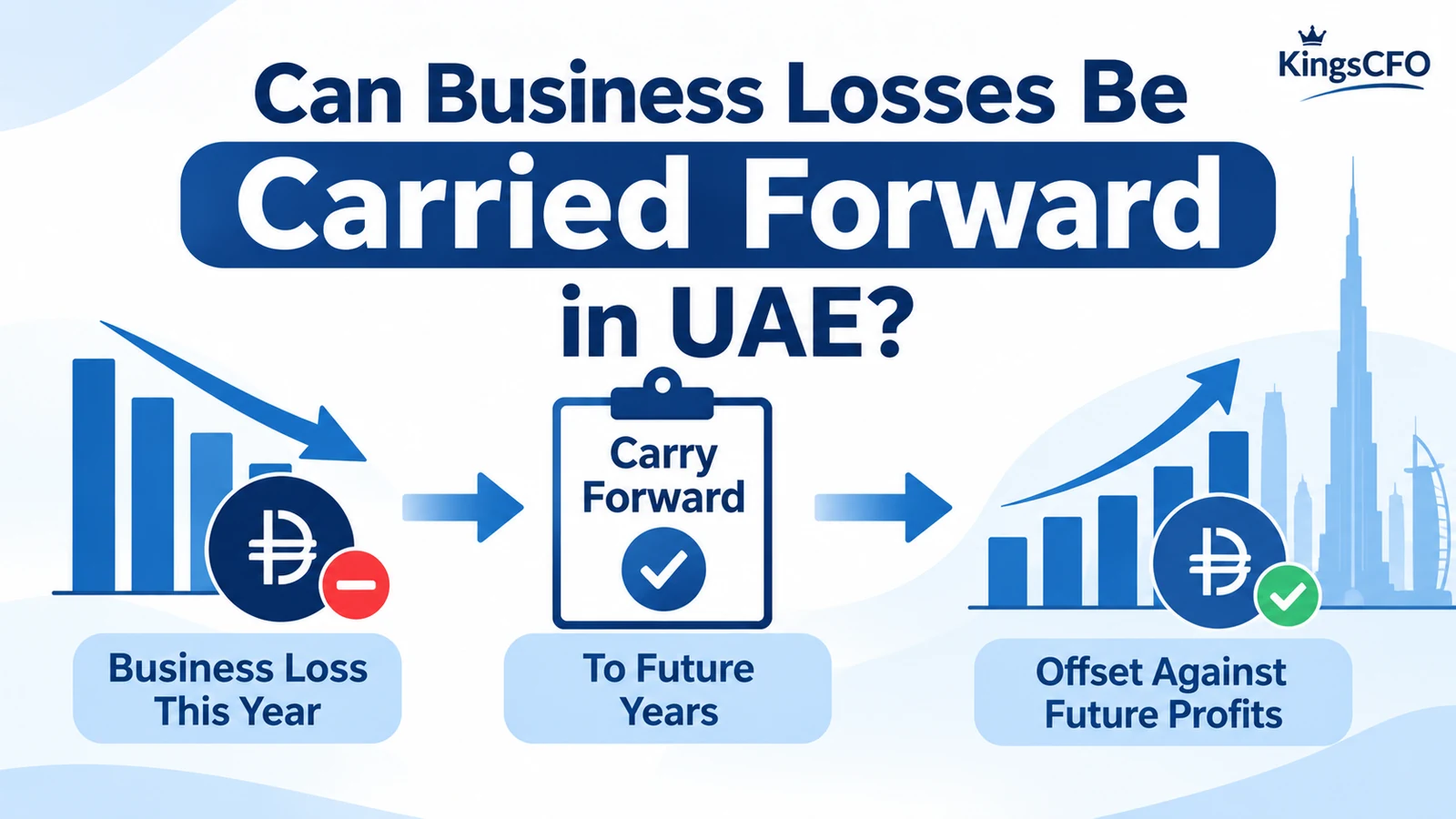
Can business losses be carried forward after a Small Business Relief (SBR) election? The Federal Tax Authority (FTA), which administers and collects UAE federal taxes, explains that eligible losses can move forward indefinitely, but annual use generally cannot exceed 75% of taxable income. An SBR period does not create a new loss for future relief.
The aim is to file correctly and budget confidently for future tax payments.
Filing under the ordinary rules can preserve an eligible loss for future years, even when SBR would produce the same zero tax bill today. That difference stood out in my reading of the loss rules alongside the SBR guidance.
A corporate tax return review should explain your calculation and filing options. Read on to work out the eligible loss, understand the annual limit, and protect your claim before a sale or closure.
When Can You Carry Forward Business Losses?
Can business losses be carried forward in the UAE? Yes. You can carry an eligible tax loss into a later UAE tax period and use it to reduce future taxable income, subject to the relevant conditions.
Your accounts give you the starting figure for working out the tax loss. The FTA’s guide to determining taxable income explains that businesses begin with their accounting net profit or loss, then apply the relevant adjustments required under Article 20(2) of the Corporate Tax Law.
For your business, following the calculation helps establish the loss you may carry into future years. Ask your tax preparer to show how each adjustment changes the accounting figure, including any expenses the tax rules partly or fully disallow.
You can then follow how the loss in your accounts becomes the loss reported for tax purposes.
Can Business Losses Be Carried Forward After Expense Adjustments?
The adjustments help establish how much loss qualifies for future relief. You may still have a useful loss to carry forward after removing disallowed expenses, but the accounting total alone cannot establish the amount.
Let’s take an example using assumed figures. Your company reports an AED 200,000 accounting loss, which already includes AED 40,000 of government fines, AED 80,000 of client entertainment and AED 50,000 of wholly private spending.
For the calculation, assume the private spending has no business purpose, forms no part of genuine staff pay or benefits, and no other tax adjustments apply.
| Item | Amount |
|---|---|
| Accounting loss | AED 200,000 loss |
| Government fines added back | AED 40,000 |
| Disallowed half of client entertainment added back | AED 40,000 |
| Wholly private spending added back | AED 50,000 |
| Total upward adjustments | AED 130,000 |
| Tax loss after adjustments | AED 70,000 loss |

The treatment follows Articles 28, 32 and 33 of the Corporate Tax Law. Business expenses must meet the deduction rules, qualifying client entertainment generally receives a 50% deduction, and the law disallows fines and penalties except compensation for damages or breach of contract.
The AED 130,000 difference between the accounting loss and tax loss is what makes me want to see the adjustment working paper during an accounting and reconciliation review.
A paper that lists each adjustment, its supporting document and the tax rule behind it lets you trace how the company reached the AED 70,000 loss. You can then check the calculation before relying on the balance in a future return.
A payment from the company account still needs a business-purpose check under Article 28. Ask your accountant to identify what the payment covered and who benefited. The answers help distinguish wholly private spending from genuine business expenses or employment benefits before your preparer applies the deduction rules.
For example, a business-related visa fee may qualify for a deduction if it meets the business-expense rules, while Article 33 disallows government fines. Separating the fee from any penalty lets your preparer apply the relevant rule to each charge and calculate the loss accurately.
Separate Eligible Tax Losses From Older Accounting Losses

Can business losses be carried forward from every year on your books? Not always. Separating losses by period helps you identify the amount available for relief without losing track of the business’s wider accounting history.
Article 37 excludes losses incurred before corporate tax commenced, before the person became subject to the tax, or from assets and activities whose income is exempt or otherwise excluded.
The FTA’s clarification on the first tax period explains how a company’s financial year helps establish its first corporate tax period. Your registration date alone does not establish which losses qualify.
Ask your preparer to identify the first period that applied to your company, then separate earlier accounting losses from the tax-loss schedule. Establishing the starting period helps you claim the eligible balance accurately.
How Many Years Can A Business Loss Be Carried Forward?
Can business losses be carried forward for years? Yes. Eligible UAE corporate tax losses have no general fixed expiry date, provided the relevant conditions continue to hold.
If you are asking “can business losses be carried forward for three or four years?”, an unused eligible balance can remain available beyond those years. The FTA’s Corporate Tax Losses Bulletin explains the carry-forward rules and the conditions attached to using the balance.
An indefinite carry-forward period gives you room to plan across future profitable years. Keep the loss history alongside the amount, though, because ownership and business changes can affect eligibility.
The useful part of a loss schedule, in my reading of the FTA’s guidance, is the history behind the total. The FTA requires businesses to use the oldest eligible losses first, so separate yearly entries help explain which balance to claim next.
Give each loss period its own entry, showing the original amount, deductions, transfers and remaining balance. You can then follow how the company reached the figure in its return.
The FTA also requires businesses to use available losses to the fullest permitted extent. You cannot preserve an eligible loss for a preferred future year when the rules require you to use it now.
How Much Of A Business Loss Can You Carry Forward?
Can business losses be carried forward without a yearly cap? No. You can preserve an eligible unused loss balance, but the amount you use in a profitable period generally cannot exceed 75% of taxable income before loss relief.
The limit concerns annual use and does not permanently remove 25% of your losses. Any eligible amount left after the deduction can continue into later periods, subject to the conditions.
Can Business Losses Be Carried Forward In Full?
An eligible unused balance can move into later periods. To calculate the deduction for a profitable period, compare the losses available with 75% of taxable income before loss relief, then use the lower amount.
For a second example, assume a company has AED 1,200,000 of eligible losses from 2025 and AED 800,000 of taxable income before loss relief in 2026.
We will use ordinary corporate tax rates, no SBR election in either illustrated year and no other reliefs or credits.
| Calculation For 2026 | Amount |
|---|---|
| Eligible losses available | AED 1,200,000 |
| Taxable income before loss relief | AED 800,000 |
| Annual limit at 75% | AED 600,000 |
| Loss used | AED 600,000 |
| Taxable income after loss relief | AED 200,000 |
| Loss available for later periods | AED 600,000 |
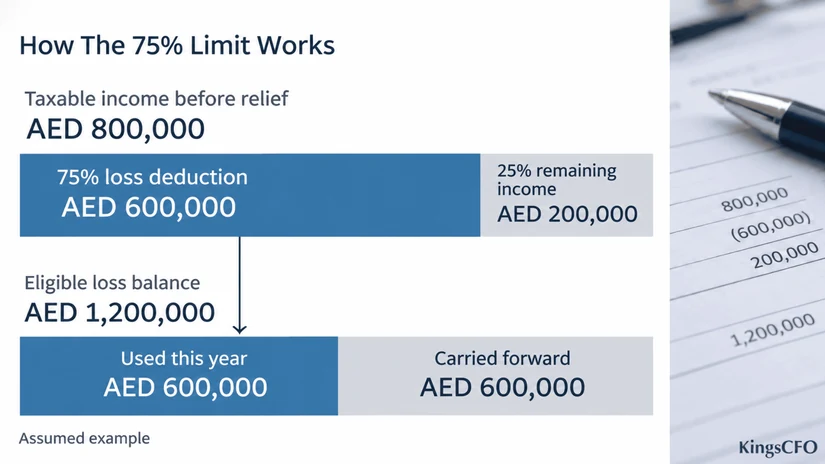
The company uses AED 600,000 and carries the remaining AED 600,000 forward. It retains the unused balance because the annual limit restricts the current deduction.
With only AED 300,000 of eligible losses, the company would use AED 300,000. The 75% ceiling cannot increase the losses actually available.
Apply The Tax Rates After Deducting The Loss
Can business losses be carried forward to cut the final bill? Here is how. Our example becomes more encouraging when we follow the loss deduction through to the tax bill. The company has AED 200,000 of taxable income left after relief, which falls entirely within the ordinary 0% band.
Cabinet Decision No. 116 of 2022 sets a 0% rate for the first AED 375,000 of taxable income and 9% above that amount, so the company owes AED 0 under our assumptions.
For me, the useful lesson is to carry the calculation all the way through when estimating future tax payments. The 75% limit tells you how much loss you can deduct, and applying the tax bands to the remaining income gives you the bill to budget for.
A different result follows if accounting adjustments turn a loss into positive taxable income. Suppose the earlier AED 200,000 accounting loss required AED 600,000 of upward adjustments, leaving AED 400,000 of taxable income.

Under ordinary rates, only AED 25,000 exceeds the zero-rate band. Multiplying AED 25,000 by 9% gives AED 2,250 of corporate tax before any other reliefs or credits.
Ask your preparer to show income before relief, the loss deducted, income after relief and tax payable together. You can then see how each stage affects the final bill.
Follow The Remaining Loss Into The Next Profitable Year
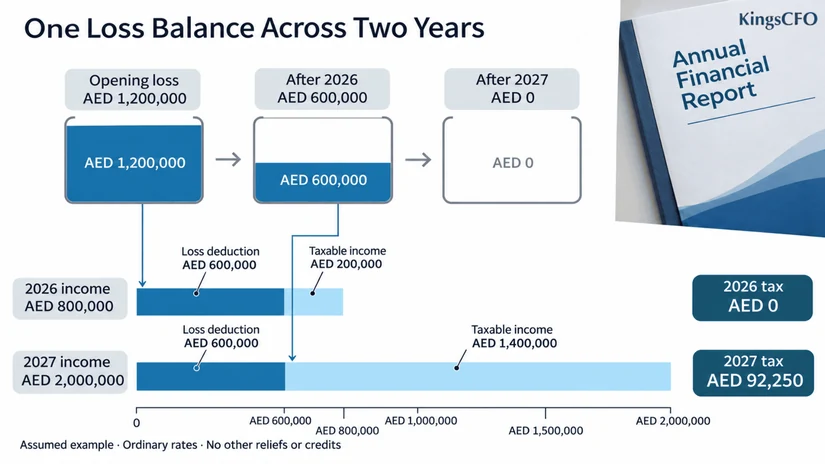
Can business losses be carried forward until they are fully used? In this example, yes. Continue with the company that finishes 2026 holding AED 600,000 of unused losses. Let’s assume its 2027 taxable income before loss relief rises to AED 2,000,000, with the same ordinary-rate assumptions.
| Year | Income Before Loss Relief | Loss Used | Loss Remaining |
|---|---|---|---|
| 2026 | AED 800,000 | AED 600,000 | AED 600,000 |
| 2027 | AED 2,000,000 | AED 600,000 | AED 0 |
The 2027 annual limit is AED 1,500,000, but the company can use only its remaining AED 600,000. Deducting the loss leaves AED 1,400,000 of taxable income, and the ordinary rate calculation produces AED 92,250 of tax.
The arithmetic is AED 1,400,000 minus the AED 375,000 zero-rate band, multiplied by 9%.
Across the two years, the losses bring the company’s 2026 bill to zero and reduce its 2027 taxable income by AED 600,000. Its cash forecast must still allow for the AED 92,250 bill in the second year.
Notice that the company uses losses in 2026 even though its final bill is zero. The mandatory deduction also reduces some income that would already fall within the 0% band, so the value of a loss is not automatically 9% of its amount.
When planning future tax payments, use the remaining loss balance and expected taxable income together, then show when the resulting bill falls due.
Carry-forward relief can reduce a later tax bill, but it does not put cash into the bank during the loss-making year.
Can Company Losses Be Carried Forward After Ownership Changes?
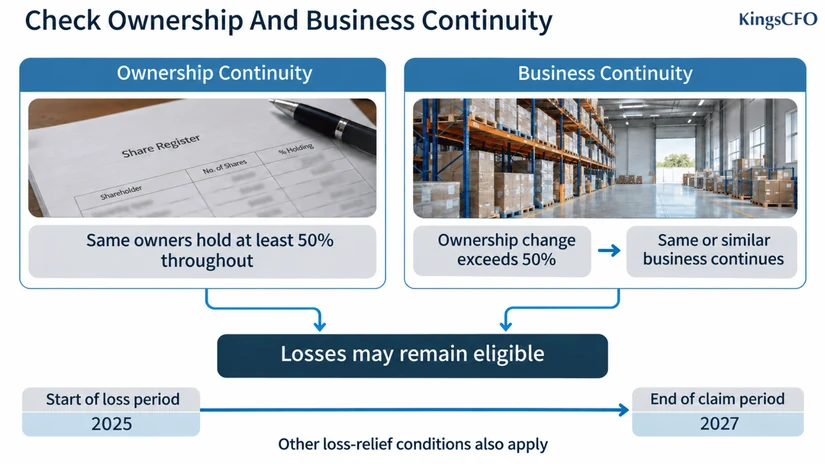
Can business losses be carried forward after a share sale? It depends on two tests. A share sale can preserve the company’s access to eligible losses when it meets the ownership or business-continuity conditions. Checking the proposed transaction against those conditions helps you assess the loss position before signing.
Under Article 39, the same person or persons must continuously hold at least 50% from the start of the loss period through to the end of the period when the company claims relief.
If ownership changes by more than 50%, the same-or-similar-business condition provides another route to retaining eligible losses.
For a 2025 loss that the company claims in 2027, review the ownership history from the beginning of the 2025 loss period to the end of the 2027 claim period. Checking only the shareholders on the sale date would leave part of the required period unexplained.
Suppose a founder sells 60% of the company. Can business losses be carried forward if the buyer continues its existing trade? The losses can remain eligible, subject to the same-or-similar-business test and the other conditions.
The law considers the assets still in use, changes to the business’s core identity and operations, and how later changes developed from the earlier business. A buyer who replaces the operation with an unrelated trade may fail the test.
The Article 39 ownership restriction does not apply to companies with shares listed on a recognised stock exchange.
A financial review before a business transaction can compare forecast tax payments with and without the historical losses. You can then see how losing access to relief could change the company’s future cash needs.
Have the tax adviser confirm eligibility before relying on either forecast.
Compare Future Loss Relief Before Selecting Small Business Relief
SBR offers eligible businesses simpler compliance and treats them as having no taxable income for the elected period. For a loss-making business, compare the simpler filing with the opportunity to preserve a loss under the ordinary rules.
If you select SBR, can business losses be carried forward from the loss-making period? The FTA’s Small Business Relief Guide explains that the tax-loss rules do not apply for the elected period, so the loss cannot become a new carried-forward balance.
Let’s return to the assumed AED 70,000 tax loss from the expense example. If the company qualifies for SBR and also meets the ordinary loss carry-forward conditions, the two filing options produce the following results.
| Filing Choice | Current Corporate Tax | New Loss Available For Later Periods |
|---|---|---|
| Ordinary rules | AED 0 | AED 70,000 |
| SBR election | AED 0 | AED 0 |
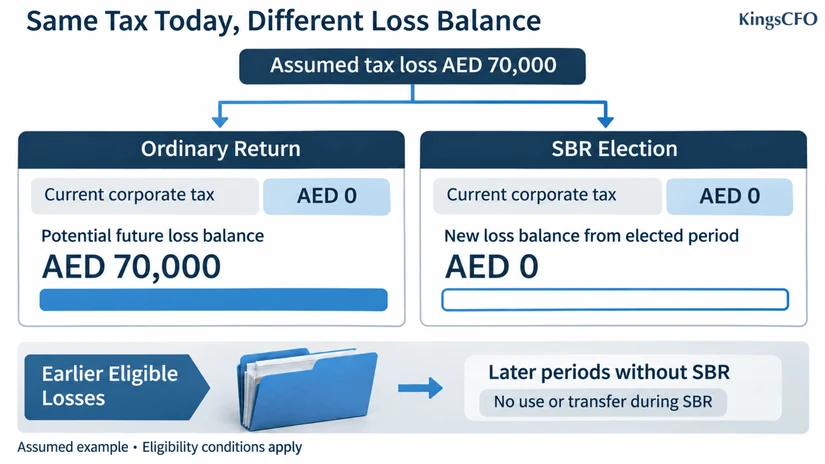
Filing under the ordinary rules preserves AED 70,000 for possible future use while leaving the current corporate tax bill at zero under our assumptions.
Simpler compliance may still have value, so compare the filing work involved with the likely future use of the loss. Future profits, the annual deduction limit and applicable tax rates determine the eventual benefit.
The FTA’s SBR guide explains that earlier eligible losses can remain available for later periods without SBR. During the elected period, the company cannot use or transfer those earlier losses, and it cannot create a new tax loss.
The question I take from the guide is how much eligible loss each filing option leaves available for the next profitable period. A zero tax bill tells you what the company owes now, and checking the remaining loss balance helps you understand the potential relief later.
According to the guide, eligibility generally requires UAE residence and revenue no higher than AED 3 million in the current and all earlier tax periods. Qualifying Free Zone Persons, known as QFZPs, cannot claim SBR.
The guide also excludes constituent companies of multinational groups covered by the UAE country-by-country reporting rules, which use a consolidated group revenue threshold of AED 3.15 billion.
The Ministry of Finance’s August 2026 announcement extended SBR to eligible tax periods ending on or before 31 December 2029. Read older guidance showing a 2026 end date alongside the extension.
Before selecting SBR, ask your preparer to compare the current filing work, eligible loss balance and expected profits over the next few years. The comparison helps you assess the immediate convenience and potential future relief together.
Review Loss Transfers Before Selling Or Closing The Company
Can business losses be carried forward after the company closes? No, they are forfeited on deregistration. An eligible transfer may allow another company to use losses before the loss-making company closes. The opportunity depends on the legal conditions and ownership history, so review the position early in the exit plan.
Unused company losses do not automatically move to a shareholder’s new business. According to the FTA’s Corporate Tax Losses Bulletin, a company forfeits unused tax losses on corporate tax deregistration.
For business closures, the FTA’s deregistration service asks for the licence-cancellation document and financial statements through the cancellation date. The company must also complete its corporate tax deregistration requirements.
Under Article 52, the FTA generally makes deregistration effective from the date the business ceases, or another date it determines. Submitting the application later does not automatically extend the period for using losses.
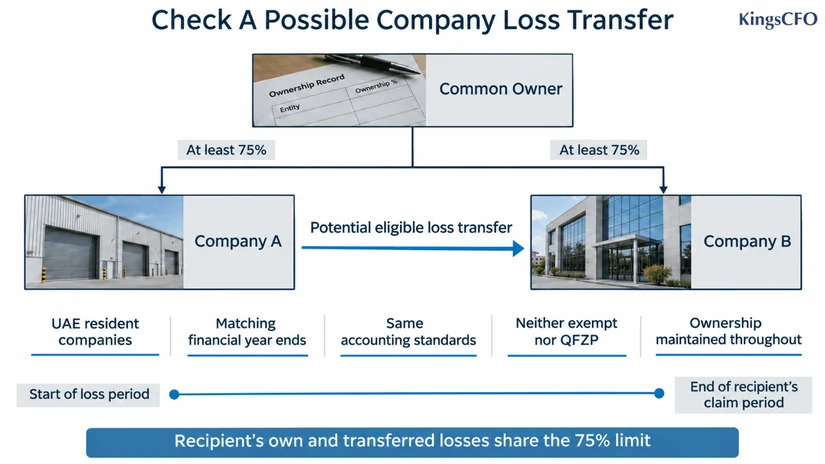
Article 38 can allow a transfer between companies without forming a tax group, subject to the required conditions.
- Both must be UAE resident legal entities, such as LLCs.
- One must own at least 75% of the other, or one common owner must hold at least 75% of each, directly or indirectly.
- The required ownership must exist from the start of the loss period through to the end of the period in which the receiving company uses the loss.
- Neither company can be exempt or a QFZP.
- Their financial years must end on the same date, and both must use the same accounting standards.
The receiving company’s own losses and transferred losses together remain subject to the annual 75% limit. A company must also use its own carried-forward losses to the required extent before using transferred losses or transferring a remaining balance.
Ask your adviser to check any possible transfer before the company ceases business. Map the ownership dates alongside the available losses, because owning another company at the time of closure does not establish the required historical ownership.
Can Business Losses Be Carried Forward By A Free Zone Company?

A free zone company that follows the ordinary corporate tax rules can carry eligible losses forward. A QFZP follows a special regime with different treatment for qualifying income and other taxable income.
The FTA Free Zone Persons Guide explains how eligible losses in the taxable-income component can move forward under the relevant conditions. Losses relating to qualifying income cannot move forward for tax relief.
Intellectual-property income has separate restrictions. For example, a QFZP cannot automatically use losses from another taxable activity against non-qualifying intellectual-property income, so royalties and related losses need a separate review.
A QFZP also cannot transfer losses to another taxable person or receive transferred losses, and it does not receive the ordinary AED 375,000 zero-rate band.
Confirm the company’s tax status and the income category behind each loss before using the calculations shown earlier.
File The Loss And Keep Records That Explain The Balance
Can business losses be carried forward without records? Your claim depends on them. Filing the return and keeping a clear loss schedule gives you a documented starting point for future claims. A loss-making business still needs to file the applicable return even when it has no tax to pay.
Article 53 generally sets the deadline at nine months after the tax period ends, subject to any different date directed by the FTA.
If an earlier return shows the wrong loss, compare the filed amount with the correct tax calculation before making a later claim. The FTA Tax Returns Guide explains that errors from earlier periods do not all follow the same correction route.
Ask your preparer to record the affected period, incorrect figure, corrected figure, tax effect and required correction. Resolving the earlier error gives the next return a supported opening balance.
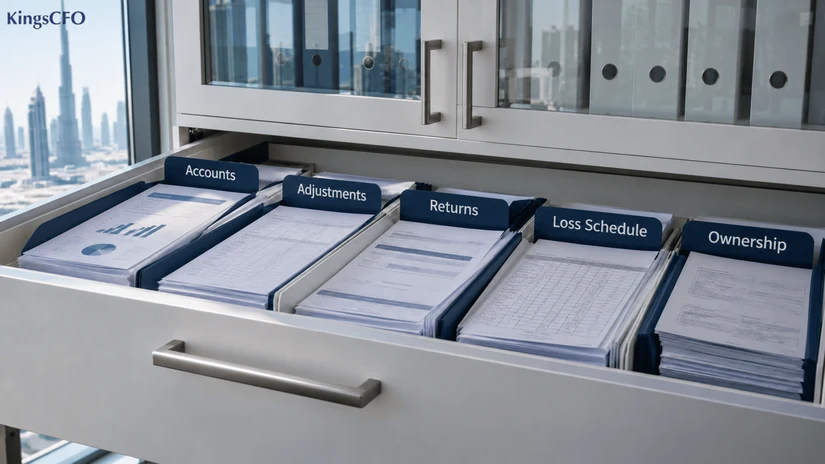
Keep the following records together so another person can follow the claim.
- Financial statements and the trial balance, which lists the account balances.
- The tax calculation and documents supporting each adjustment.
- Earlier returns and filing confirmations.
- A schedule recording losses arising, used, transferred and remaining.
- Ownership documents relevant to the carry-forward or transfer conditions.
Our audit preparation checklist explains how to connect reported figures with supporting records. Article 56 requires businesses to retain relevant records for seven years after the tax period to which they relate.
For your loss file, keep the original calculation alongside the schedule of later claims. The documents help explain where the loss came from, how much the company has already claimed and how you calculated the remaining balance.
Assign responsibility for preparing the schedule, checking the tax treatment and filing the return so everyone works from the same confirmed figures. Our guide to choosing suitable accounting support can help you define those responsibilities.
Confirm The Loss Available Before Your Next Return
A supported loss balance gives you something useful to plan with. You can estimate future tax more clearly, compare relief elections and assess the effect of a proposed sale.
Before approving the return, ask your preparer one specific question. Can business losses be carried forward from each year in your schedule?
The explanation should connect the original tax loss, previous deductions, relief elections and ownership changes with the remaining balance. You should leave the review knowing how much the company can claim and which records support the amount.
At KingsCFO, we help UAE SMEs with accounting, corporate tax compliance and financial planning. Discuss your loss calculation with our team and bring your accounts, previous return and loss schedule so the team can reconcile the remaining balance.
Share any planned ownership changes too, so the review can address their effect on future claims.
FAQs
Can Business Losses Be Carried Forward By A Sole Proprietor?
An individual subject to UAE corporate tax on their business can carry eligible tax losses forward under the applicable rules. Personal spending does not qualify simply because the owner paid it from a business account.
Does Carrying A Loss Forward Give Me A Cash Refund?
Carry-forward relief reduces eligible future taxable income and does not itself create a cash refund for the loss-making year.
Can I Use Losses From Before Corporate Tax Started?
Losses from before corporate tax commenced, or before the person became subject to the tax, do not qualify for the relief.
Can I Carry A UAE Tax Loss Back To An Earlier Year?
No. UAE corporate tax losses cannot reduce taxable income from a previous tax period.
What If My Previous Return Missed The Loss?
Have your preparer compare the filed return with the correct tax calculation and complete the required correction before relying on the loss in a later claim.

Mayur Bardoloi is a content writer with more than four years of experience across writing and proofreading. His content for KingsCFO explains financial topics and CFO services for business owners who may not have a finance background.