You have people willing to invest in your UAE business, but can you accept their money or share an offer online? Before you crowdfund, you need to know which approvals apply and what you can promise contributors.
The UAE’s Cabinet Resolution No. 36 of 2022 provides a framework for equity crowdfunding, with later amendments. The rules cover who can apply, what the offer must disclose, and how the campaign handles contributions.
You want enough funding to carry out your plan, repayments the business can manage, and ownership terms you understand before signing.
Start with what contributors will receive, identify the relevant rules, and prepare figures explaining how much money you need and how you will use it. KingsCFO’s financial preparation for raising capital can help you organise those forecasts and supporting records.
Read on to learn how to crowdfund through an appropriate platform, prepare the documents, compare costs and ownership, and recognise when changes to billing or collections could reduce the amount you need to raise.
Is Crowdfunding Legal In The UAE?
Yes, you can crowdfund through routes permitted under the relevant UAE framework. Start with an authorised platform whose permissions cover your proposal, then meet the applicant requirements, project approvals, disclosures, and payment rules.
A business seeking funding has different responsibilities from a company operating the platform. Your normal business licence does not, by itself, approve a regulated investment offer.
Choose What You Will Offer Contributors
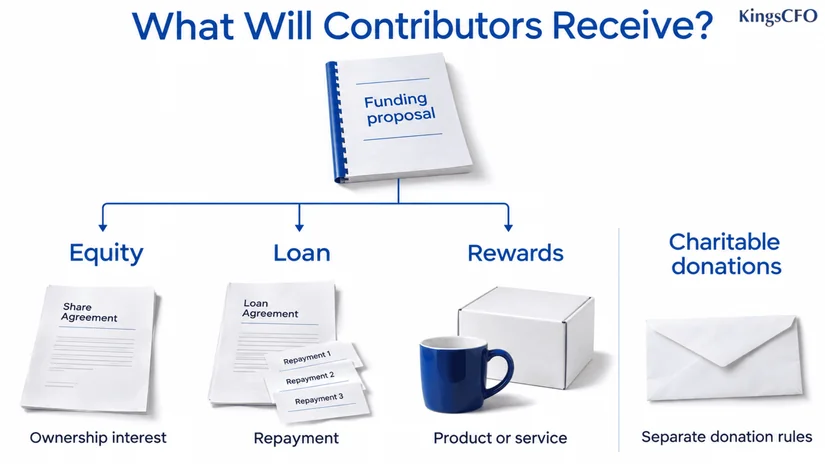
The rules for crowdfunding in the UAE depend partly on what people receive in exchange for their money.
| Funding model | What contributors receive | What you need to assess |
|---|---|---|
| Equity | An ownership interest under the agreed structure | Ownership percentage, voting rights, and exit terms |
| Loan-based funding | Repayment under financing terms | Instalments, charges, security, and repayment capacity |
| Rewards or pre-orders | A stated product, service, or reward | Delivery costs, deadlines, refunds, and trading requirements |
| Charitable donations | No commercial return | Separate donation rules and permissions |
If you crowdfund through equity, explain the ownership and rights investors receive. For a loan, show how repayments fit the business’s expected cash receipts. A product campaign needs a budget for fulfilling every promised order.
Identify The Regulator Covering The Platform
The federal loan-based framework falls under the Central Bank of the UAE, or CBUAE. Federal equity crowdfunding falls under the Capital Market Authority, or CMA, formerly the SCA. The regulator’s name changed in January 2026.
Platforms operating in or from the Dubai International Financial Centre follow the Dubai Financial Services Authority, or DFSA, framework. Abu Dhabi Global Market has a separate Financial Services Regulatory Authority, or FSRA, framework for private financing platforms.
Find the operator’s named regulator and permitted activities first. Then establish which applicant requirements apply to your company and proposal.
Charitable fundraising follows separate restrictions. Federal Law No. 3 of 2021 prohibits natural persons from collecting donations and sets permit requirements for entities outside the permitted categories. Its scope concerns charitable and humanitarian fundraising, so it should not be treated as a general funding route for commercial ventures.
How To Crowdfund A Business In Seven Steps
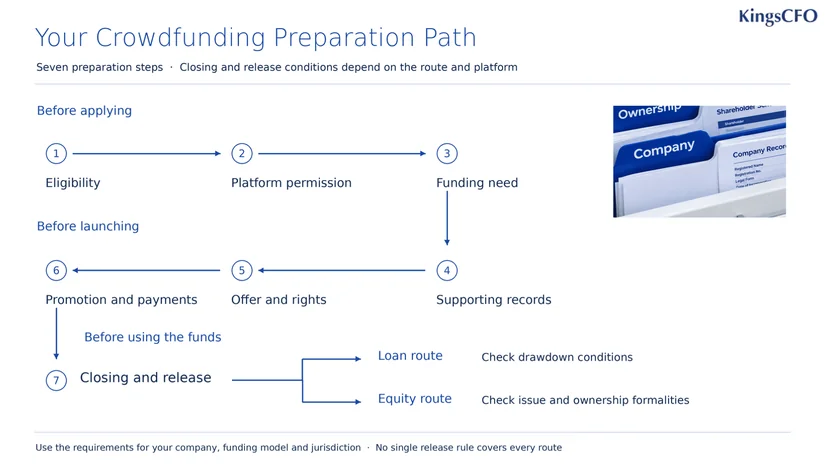
Work through these steps before publishing an offer or collecting contributions.
1. Establish If Your Business Can Apply
Obtain the platform’s current applicant criteria, then compare them with your company documents and proposed use of the money.
Under the federal equity framework, Article 3 excludes certain applicants, including joint stock companies, investment funds, businesses operating in securities, insurance or banking, and companies seeking money to lend or invest in other existing companies.
The equity framework can cover a company already established or one to be established for the project. By comparison, the CBUAE loan framework defines its borrower as a UAE-registered company, including sole proprietors.
If you want to crowdfund before trading begins, ask the platform for its incorporation, sector, trading-history, and financial-record requirements. Its acceptance criteria may go beyond the legal minimum.
While reading the rules, I separated the platform operator’s requirements from the founder’s requirements. That helped me see which conditions a business must meet before applying for funding.
Where company formation remains unresolved, business structure and setup guidance can help you organise the formation questions to discuss alongside regulatory advice.
2. Read The Platform’s Authorised Activities
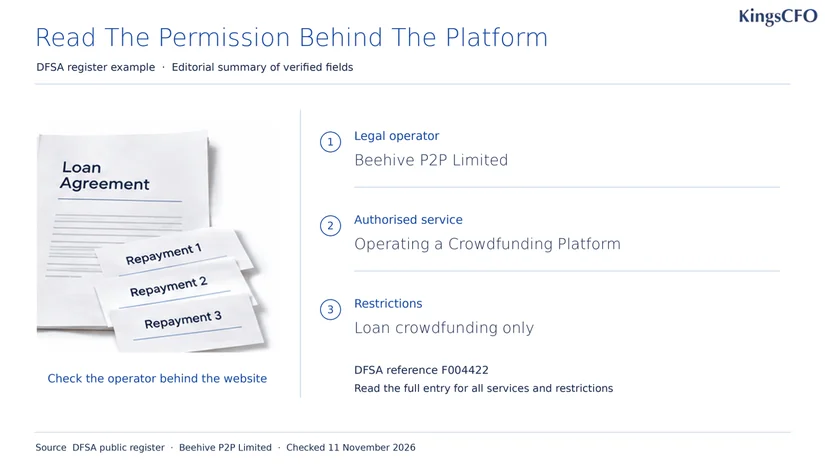
Find the legal operator named in the platform’s terms and match that name with the relevant regulator’s register.
Read its current status, authorised services, and restrictions. Permission to arrange property investments may not cover business loans, so the activity listed in the register matters.
For example, the DFSA register entry for Beehive P2P Limited restricts its crowdfunding activity to loan crowdfunding. You would then need to examine its current applicant criteria to establish if your business could apply.
When comparing crowdfunding platforms, keep four details together
- The operator’s legal name
- Its regulator
- The funding activity it may conduct
- Its applicant requirements
Apply the same checks to overseas crowdfunding websites. A foreign licence or an accessible website does not establish that your UAE proposal and promotion meet all relevant requirements.
3. Explain Why You Need To Crowdfund
Write a one-page funding brief showing the amount required, what you will spend it on, and when the spending should produce results.
Separate equipment, stock, hiring, project costs, and working capital. Working capital supports everyday operations while you wait for customer receipts.
Billing and collections deserve a review before you settle on the amount to crowdfund.
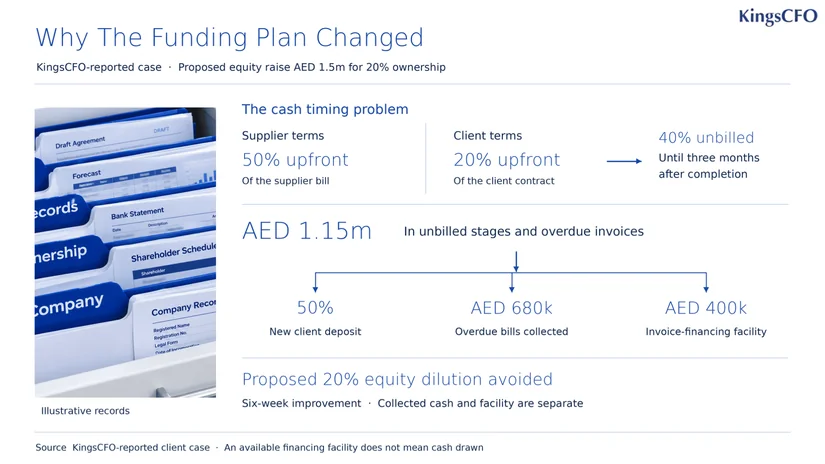
The KingsCFO finance team supplied a case involving a Dubai interior design studio with AED 4.8 million in annual revenue. Its founder considered raising AED 1.5 million for 20% ownership because two large office projects repeatedly strained cash.
The studio had a basic profit-and-loss sheet and its bank balance, but no list showing overdue invoices, project billing tracker, or 13-week cash forecast.
Over two weeks, the team reviewed contracts, supplier purchase orders, VAT returns, and a year of bank statements. Suppliers required 50% upfront, but clients paid 20% upfront, with 40% left unbilled until three months after completion.
KingsCFO identified AED 1.15 million across unbilled project stages and overdue invoices. The team reports increasing client deposits to 50%, collecting AED 680,000 of overdue invoices within a month, and arranging an AED 400,000 invoice-financing facility.
Invoice financing provides funding linked to eligible customer invoices. The facility’s limit does not mean the studio drew the full amount.
According to KingsCFO, the cash crunch improved within six weeks and the founder avoided the proposed equity dilution. The business still arranged financing, but changed its approach after examining the records.
The payment terms stood out to me because the studio paid suppliers before collecting enough money from clients. It needed cash to cover that gap. Once the team examined billing and collections, the founder could reconsider how much outside funding the business needed.
For your business, start with what customers owe, which project stages remain unbilled, and when suppliers need payment. Those records help explain the amount and timing of the funding request.
4. Prepare The Records Behind Your Figures

Request the platform’s document list early, then gather the evidence behind each requested figure.
| Area | Records to prepare or discuss |
|---|---|
| Company and ownership | Incorporation documents, licence, ownership details, and required approvals |
| Identity | Documents requested for founders, owners, and the people who ultimately own or control the business |
| Financial position | Available statements, bank records, debt schedules, and supporting accounts |
| Funding plan | Forecasts, assumptions, spending plans, and repayment calculations where relevant |
| Offer | Ownership or repayment terms, fees, risks, and required disclosures |
The CBUAE conduct requirements include borrower checks involving credit information, cash-flow forecasts, and beneficial ownership. Other frameworks have their own requirements.
To crowdfund with figures you can explain, connect the accounts to supporting records. If your bank balance and accounting balance differ, resolve the reason before submitting both.
KingsCFO can help you organise your accounting records, while our guide to preparing financial records for review explains supporting schedules and missing documents. Ask the platform which statements need an independent audit.
5. Explain The Offer And The Rights Attached To It
Your proposal should state what the money will fund, the main risks, and what contributors receive.
For equity under the federal framework, Article 7 requires preliminary project approval and disclosures covering the applicant, finances, business plan, project purpose, funding amounts, risks, material changes, and investor exit arrangements.
Its offering period is up to 15 working days, with a possible equal extension under the operator’s procedures. Allow separate time for preparing documents and the platform’s review.
Explain ownership and voting rights in plain language. For loans, review payment dates, charges, security, guarantees, and what happens after missed payments.
Evidence also helps contributors assess the campaign. In a 2014 study of 48,526 US Kickstarter projects, Ethan Mollick of the Wharton School at the University of Pennsylvania found associations between project quality, personal networks, and funding success.
The study helped me understand “project quality” through examples such as delivery plans and relevant past work. Those give contributors something concrete to assess when reading a campaign.
When you crowdfund, the campaign page, financial forecast, and agreements should describe the same proposal. Give the figures to the finance lead and the ownership, repayment, and legal terms to the appropriate legal adviser for review.
6. Agree How You Will Promote The Offer And Receive Contributions
Establish who approves campaign wording and which channels the rules permit. Cover social posts, email, WhatsApp groups, and any intended overseas audience.
A UAE financial-services lawyer described a restaurant founder who proposed raising AED 1.2 million from 24 people through Instagram and WhatsApp, calling the arrangement a joint venture.
The lawyer reports advising the founder to remove the link while the structure and promotion underwent review. In that example, 24 was the proposed investor count, not a legal threshold.
Calling an arrangement a joint venture does not settle its legal treatment. The adviser needs to examine the investment, ownership rights, decision-making arrangements, and promotion method.
For the federal equity route, Article 7 bars simultaneous presentation of the financing request on multiple platforms and collection of campaign money through external means.
Obtain the operator’s written payment instructions, including the receiving account, account holder, and how contributions reach the campaign. Under the federal equity rules, the operator holds investor money in an escrow account until the offering period ends or the offer closes.
Before you crowdfund, make sure the promotion and payment instructions fit the rules covering your offer. An operator’s policy does not replace those rules.
7. Understand The Funding Cap And Closing Requirements
Read the funding limit, target, deadline, deductions, withdrawal rights, and refund terms before treating commitments as spendable cash.
The CBUAE loan framework sets an AED 10 million borrower limit per calendar year. It also restricts a borrower to one platform listing per project and prevents access to funds before the campaign reaches 100% of its funding goal.
Under federal equity Article 7, total financing applications for the applicant and its parent, subsidiary, sister, or associated companies must not exceed AED 15 million over the company’s duration, subject to adjustment by the authority.
The two limits cover different funding routes and time periods. Use the figure that applies to your proposal.
Article 7 also requires initiating company formation or a capital increase within five working days after the offering period ends. A capital increase means formally adding share capital to an existing company. Have your legal adviser or formation agent identify the filings and who will submit them.
If you crowdfund through equity, review the closing and withdrawal provisions with the operator. Article 8 of the federal equity framework provides options to re-offer, accept the amount collected, or cancel in specified circumstances. Establish which option applies before relying on the proceeds.
Understand The Cost Before You Crowdfund
The amount raised may exceed the cash available for the business.
Obtain a written fee schedule covering application, success, administration, legal, and other relevant charges. For each charge, record when it becomes payable and what happens if the campaign fails.
Include deductions from proceeds, ongoing servicing costs, and any applicable taxes in the comparison. These are items to investigate, not a claim that every platform charges all of them.
Compare Usable Cash And Financial Commitments
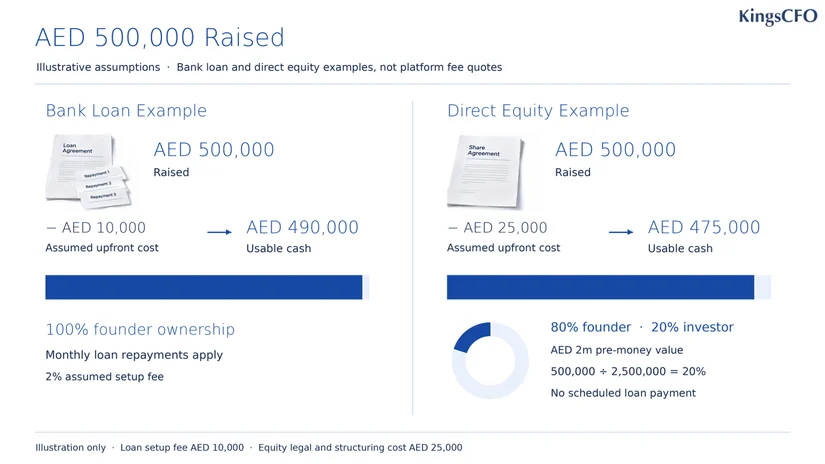
A CFO supplied this teaching example using an AED 500,000 raise. It compares a bank loan with a direct equity investment to explain the financial choices. The figures are assumptions, not crowdfunding platform quotations.
| Item | Illustrative loan | Illustrative equity investment |
|---|---|---|
| Amount raised | AED 500,000 | AED 500,000 |
| Assumed upfront costs | AED 10,000 | AED 25,000 |
| Initial usable cash | AED 490,000 | AED 475,000 |
| Main assumption | 24 monthly payments at 12% annual reducing-balance interest | AED 2 million value before investment |
| Commitment illustrated | About AED 23,537 monthly | 20% ownership |
The loan produces approximately AED 64,882 in interest over two years, plus the assumed upfront fee. Review any additional charges, security, guarantees, and repayment conditions in an actual offer.
For equity, AED 500,000 divided by the AED 2.5 million post-investment value produces a 20% stake, before other changes.
Use written offers to test the financial effect of your growth plan before choosing how to crowdfund.
Use A Cash Forecast To Judge Loan Payments
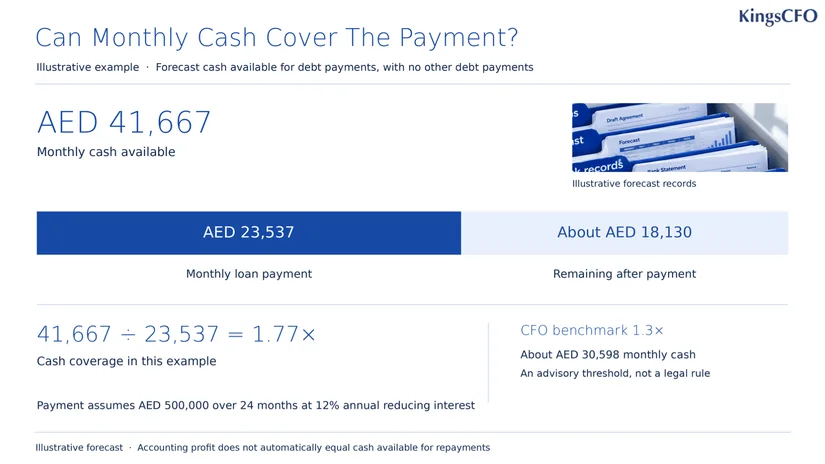
The CFO’s example assumes AED 2.5 million in annual revenue and AED 500,000 in annual profit.
I could calculate the monthly loan payment from the terms, but assessing affordability needed a cash forecast. The annual profit did not show how much cash would remain after the business paid its other bills.
IAS 7 explains how cash flow differs from profit, including adjustments for non-cash items and payment timing.
If the forecast independently shows AED 41,667 monthly available for loan payments, with no other debt payments, it covers the example instalment about 1.77 times.
The CFO uses 1.3 times as a screening threshold, requiring about AED 30,598 monthly in this example. That is an advisory benchmark, not a universal approval rule.
Before you crowdfund through loans, test lower sales, late customer payments, and existing debt commitments.
Read The Rights Attached To An Equity Stake
If annual profit later reaches AED 1 million, a 20% investor receives AED 200,000 only if the business distributes all that profit proportionally under the agreed terms.
Similarly, 20% of AED 4 million in distributable equity sale proceeds is AED 800,000, assuming no different rights or adjustments.
Read the shareholder terms alongside the ownership percentage. Special payment or decision rights can change what an investor receives and which decisions need their approval.
Plan Repayments And Investor Updates
Once you crowdfund, track spending against the agreed purpose and assign responsibility for each reporting or payment deadline.
For loans, maintain a repayment forecast. Equity funding brings reporting and approval commitments under the agreements and applicable rules.
Prepare a short monthly view of cash, spending, progress, and risks. Report material changes through the required process, and update the forecast when customer receipts or project dates move.
Ongoing CFO support for forecasts and reporting can connect those commitments with your monthly accounts.
Prepare Your Numbers Before You Crowdfund
Gather your company documents, current accounts, funding target, and proposed investor terms. These give your finance and legal advisers a specific proposal to examine.
You can discuss your funding preparation with KingsCFO to review the financial assumptions and identify missing records before proceeding with the application and legal review.
FAQs
Is Crowdfunding Legal In The UAE?
Yes, when the platform, applicant, offer, approvals, and payment process meet the requirements of the relevant framework.
Can You Crowdfund To Start A Business?
Potentially, because some equity routes cover companies to be formed, but platform acceptance and incorporation requirements still apply.
What Are The Requirements For Crowdfunding?
Establish eligibility, operator permissions, project approvals, required records, disclosures, offer terms, and the permitted collection process for your route.
Do I Need A Platform Operator Licence To Raise Money?
Applying as a business seeking funding does not itself make you a platform operator, but separate company and project approvals may apply.
Can A UAE Business Use Overseas Crowdfunding Websites?
Assess platform eligibility and the laws covering the offer and promotion first, because overseas access alone does not establish compliance.
What Happens If The Campaign Misses Its Target?
CBUAE loan borrowers cannot access funds before reaching 100% of the target; federal equity offers follow their applicable closing, withdrawal, and refund provisions.

Mayur Bardoloi is a content writer with more than four years of experience across writing and proofreading. His content for KingsCFO explains financial topics and CFO services for business owners who may not have a finance background.